Why Choose This Computer Vision Certificate Course
Learn why techcadd's Computer Vision Certificate Course offers top practical training in PyTorch, YOLO, vision models, and job-ready skills.
Mastering Computer Vision: Architecting Intelligent Visual Systems
Course Description
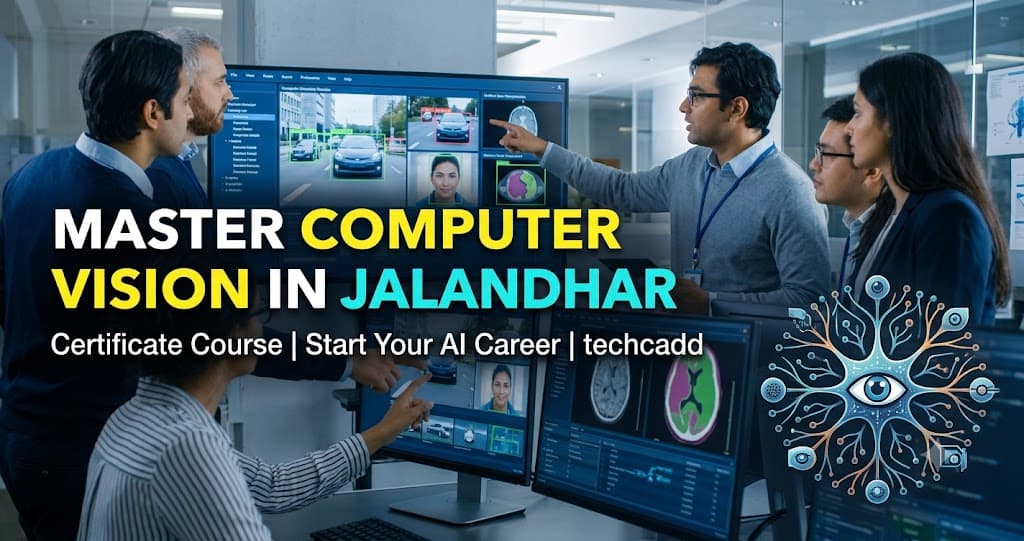
In an era dominated by artificial intelligence, visual data has become one of the most powerful mediums of information. The Computer Vision Certificate Course is an intensive, practical program designed to bridge the gap between theoretical deep learning concepts and real-world visual AI applications. From enabling autonomous vehicles to perceive their surroundings to empowering healthcare systems with automated medical imaging analysis, Computer Vision (CV) is driving the next generation of technological innovation.
This course offers a hands-on journey through fundamental image processing techniques, classical computer vision methods, and state-of-the-art deep learning architectures. Students will work with industry-standard frameworks such as OpenCV, PyTorch, TensorFlow, YOLO, and MediaPipe to build robust visual recognition, object detection, segmentation, and tracking engines.
Whether you are a software engineer looking to transition into AI, a data scientist aiming to specialize in spatial computing, or an innovator building automated tools, this course equips you with the end-to-end skills needed to design, deploy, and scale vision models in production environments.
Why Choose This Computer Vision Certificate Course?
High-Demand Skill Set in a Rapidly Growing Market
Computer Vision is at the heart of breakthroughs in robotics, autonomous driving, retail automation, spatial computing (AR/VR), security, and biometric technology. Gaining expertise in CV opens doors to high-paying specialized roles across global industries.
Project-Based, Industry-Aligned Curriculum
Theory alone isn't enough. You will build a portfolio of real-world projects—including real-time object tracking, facial recognition systems, automated defect inspection, and deep learning-based image segmentation—demonstrating immediate value to potential employers.
Mastery of State-of-the-Art Deep Learning Frameworks
Move beyond basic pixel manipulation. Learn to build and fine-tune modern Convolutional Neural Networks (CNNs), Vision Transformers (ViTs), Generative Adversarial Networks (GANs), and real-time object detectors like YOLO (You Only Look Once).
Edge Deployment and Production Engineering
Discover how to optimize heavy deep learning models for real-world deployment on edge devices (like Raspberry Pi, NVIDIA Jetson, and mobile platforms) using tools like TensorRT, ONNX, and OpenCV DNN.
Industry-Recognized Certification
Earn a verified Certificate of Completion that validates your practical expertise in computer vision engineering, enhancing your resume and LinkedIn profile for top tech recruiters.
Key Modules Covered
Module 1: Foundations of Digital Image Processing
Image representation, color spaces (RGB, HSV, LAB), histogram equalization, spatial filtering, edge detection (Sobel, Canny), and contour analysis using OpenCV.
Module 2: Feature Detection & Classical Computer Vision
Interest point detection, corner detection (Harris, Shi-Tomasi), feature descriptors (SIFT, SURF, ORB), image stitching, and feature matching.
Module 3: Deep Learning for Visual Perception
Neural network fundamentals, Convolutional Neural Networks (CNNs), transfer learning (ResNet, EfficientNet, VGG), and data augmentation strategies using PyTorch/TensorFlow.
Module 4: Object Detection, Tracking & Instance Segmentation
Bounding box regression, two-stage detectors (Faster R-CNN), single-stage detectors (YOLO, SSD), semantic vs. instance segmentation (U-Net, Mask R-CNN), and multi-object tracking (SORT/DeepSORT).
Module 5: Advanced Topics: Generative AI & Vision Transformers
Vision Transformers (ViT), image generation and translation with GANs (DCGAN, CycleGAN), pose estimation, and 3D vision basics.
Module 6: Model Optimization & Edge Deployment
Model quantization, pruning, converting models to ONNX/TensorRT, and deploying vision pipelines to local APIs and edge devices.
Who Should Enroll?
Software Developers & Engineers wanting to add spatial AI and perception capabilities to their tech stack.
Data Scientists & Machine Learning Engineers seeking specialization in unstructured visual data analysis.
Robotics & IoT Enthusiasts building hardware systems that require real-time visual perception.
Students & Researchers aiming to build strong portfolios for AI careers or advanced academic research.
Career Opportunities Upon Completion
Computer Vision Engineer
Deep Learning / AI Specialist
Autonomous Systems Engineer
Medical Image Processing Specialist
Perception Engineer (Robotics & Self-Driving Cars)
Have a questionabout this?
Leave your number and a counsellor will call you back — about batch timings, fees, EMI options, placement record, or which track fits your degree.
- Free career counselling, no registration fee
- Weekday, evening, weekend or 1-on-1 batches
- Internship letter and placement support
Ready to get started?
Start building yourcareer today.
Talk to a counsellor today. One call is usually enough to know which track fits your degree, your schedule and the job you want.
- Free career counselling
- No registration fee
- Placement support included