Best After 12th 9-Month MERN Stack Diploma Program in Jalandhar
The longest MERN track — nine months from how the internet works to an industry-level AI-powered application, with OpenAI and Gemini integration, real-time features, a two-month capstone, DSA and a full month of placement preparation.
MERN Stack Diploma Program Course in Jalandhar
A 9-month AI-Powered Full Stack (MERN) diploma for school leavers at techcadd Jalandhar (4.9★, 556+ reviews): the complete MERN stack, OpenAI and Google Gemini API integration, AI chatbots and agents, real-time features with Socket.IO, payments, a two-month industry AI capstone, DSA and core CS, and a full month of placement preparation. 10+ mini projects. Fresher MERN roles start around ₹20,000 – ₹35,000.
Key Highlights :
- Duration: 9 Months
- Mode: Classroom & 1-on-1
- Eligibility: 12th Pass
- Includes: Placement Support
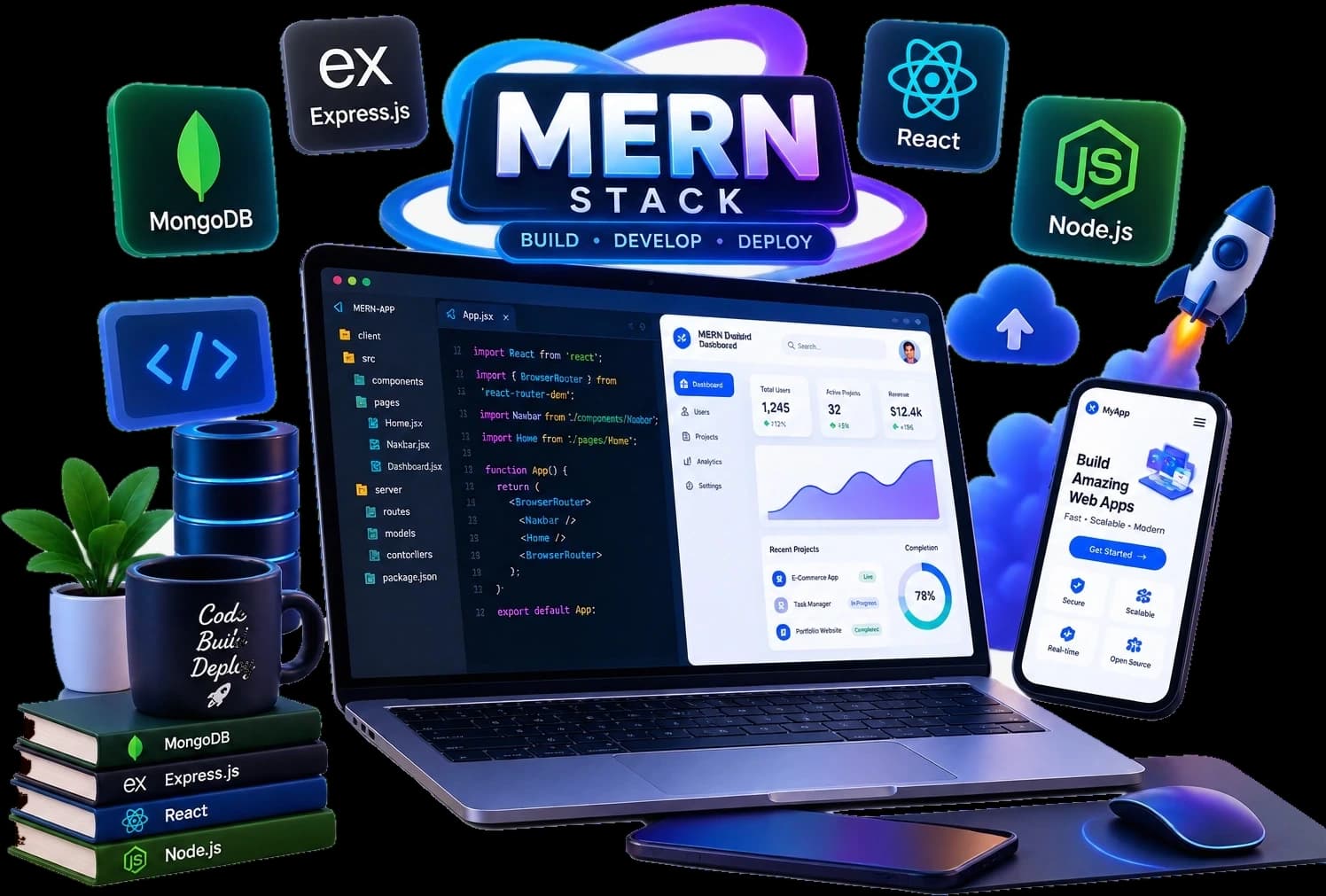
Course Overview
This is the AI-Powered Full Stack Web Development (MERN) diploma, written for someone starting straight after 12th who wants the complete route rather than the fastest one. Nine months, nine modules, one theme per month. What separates it from the three- and six-month tracks is not pace but scope: it carries a full month of AI integration, two months on a single industry-level project, and a final month given entirely to DSA, computer science fundamentals and interview preparation.
Months one to three build the front end. Month one is web fundamentals — how the internet works, client–server architecture, HTTP and HTTPS, domains and hosting — then HTML5, CSS3, Git and GitHub, and an AI tools module covering ChatGPT, GitHub Copilot, prompt engineering basics and AI-assisted debugging, closing with a personal portfolio website and responsive landing pages. Month two is JavaScript from variables to closures, ES6+, the DOM, asynchronous JavaScript with promises, async/await and the Fetch API, browser storage, and AI tools for JavaScript development — producing a calculator, a weather app, a quiz app and a notes app. Month three is React.js: fundamentals with Vite, core concepts, hooks, React Router with protected routes, API integration with Axios, Context API state, Tailwind styling, frontend JWT authentication and AI-assisted component generation, ending in a recipe finder, a blog site, an e-commerce frontend and an employee management dashboard.
Months four to six build and then advance the back end. Month four is Node.js and Express — modules, npm, routing, middleware, MVC architecture, REST API development, bcrypt and JWT authentication with role-based authorisation, backend architecture, API documentation and testing in Postman, and AI tools for backend work. Month five is MongoDB and database management: SQL versus NoSQL, Atlas, Compass, the mongo shell, query and update operators, Mongoose schemas, models, validation and custom validators, file handling with Multer, Cloudinary and Nodemailer, and AI-assisted schema design and query optimisation. Month six is advanced MERN — full stack integration, complete JWT authentication with refresh tokens and RBAC, file uploads, pagination, search, filtering, rate limiting, CORS and Helmet, real-time applications with Socket.IO, Stripe and Razorpay payments with OTP and SMS, performance optimisation and deployment, and a full module on AI integration: the OpenAI and Google Gemini APIs, AI chatbot development, content generation, recommendation systems and image generation.
Months seven and eight are one industry-level major project in two phases — planning, requirement analysis, user stories, UI/UX and architecture, then the frontend, the backend, AI feature integration, schema design and security, with code reviews and bug tracking throughout; then advanced features, AI enhancements, testing and optimisation, deployment and DevOps, documentation, a live project presentation and career portfolio preparation. Month nine is placement preparation: data structures and algorithms, technical interview questions across the whole stack, computer science fundamentals covering OOP, operating systems, DBMS, networks, SQL and SDLC, aptitude and soft skills, ATS resume and portfolio development, mock interviews with live coding rounds, and career preparation including freelancing, open source and salary negotiation.
What You'll Learn
Every module ends in something you have built and a trainer has reviewed, so the list below is work you will have done rather than topics you will have heard about.
- 01
An AI chatbot inside your own product
Not a hosted widget dropped onto a page: an Express route you wrote calling OpenAI or Gemini, with conversation state in MongoDB and a React interface over it.
- 02
Real-time features and a working checkout
Socket.IO for live data and notifications, plus Stripe or Razorpay with OTP verification and SMS — the two features clients ask for most and freshers can least often show.
- 03
Two months on one industry capstone
Authentication, RBAC, AI integration, real-time updates, payments, file upload, dashboards and REST APIs — deployed to Vercel and Render, documented, and presented live.
- 04
A month of DSA and interview preparation
Arrays through dynamic programming with complexity analysis, OOP, OS, DBMS and networks, then live coding rounds and mock interviews with written feedback.
Course Curriculum
The syllabus is a nine-month roadmap, one theme per month, and the first three months each end in named mini projects. Months 1–3 build the front end, months 4–6 build and then advance the back end including AI integration, months 7–8 are one industry-level major project in two phases, and month 9 is DSA, computer science fundamentals and placement preparation.
Month 1 — Web Development Fundamentals
- 1
Web Fundamentals — introduction to web development, how the internet works, client–server architecture, websites vs web applications, frontend vs backend vs full stack, browsers, HTTP & HTTPS, domain name & hosting
- 2
HTML5 — HTML structure, semantic tags, forms, tables, media, accessibility
- 3
CSS3 — selectors, Flexbox, Grid, animations, responsive design, media queries
- 4
Git & GitHub — Git commands, branching, merge, pull requests, GitHub workflow
- 5
AI Tools — ChatGPT, GitHub Copilot, prompt engineering basics, AI-assisted debugging
- 6
Mini projects: personal portfolio website, responsive landing pages
Tools you will actually work in
Everything here is installed on the lab machines and used on live client work, not shown once in a slide and forgotten.
- CSJERJEJMORAJSSISTMUCLNOGPTGGVSMCMANPCDRE
Who can do this course
Students straight out of 12th
Any stream. Module 01 starts at how the internet works, and nine months is long enough to go from that to an AI-powered application deployed on a live URL without ever feeling rushed.
Students aiming at product companies
Month nine is the reason to choose this length. DSA, OOP, operating systems, DBMS, networks and SQL are what written rounds and technical interviews test, and no shorter track carries them.
Students doing a degree alongside
Nine months of evenings or weekends runs comfortably beside a BCA, B.Sc IT or first-year B.Tech, and finishes with a capstone your college project cannot match.
Anyone who wants the AI half
The OpenAI and Gemini integration in month six, and the AI features carried through the capstone, are what separate this from a standard MERN course. Very few freshers in Punjab can show a working AI feature.
Career restarters and switchers
A gap or an unrelated background counts for less than a deployed application someone can open. The syllabus is identical whoever you are; only the batch timing changes.
Aspiring freelancers
Month nine covers freelancing basics, open source contribution, LinkedIn networking and rate negotiation, on top of the payments, OTP and deployment work that paying clients actually ask for.
Why this programme is worth your year
The complete MERN curriculum
The full stack in depth and in order — HTML5 and CSS3, JavaScript to closures and async, React with hooks and routing, Node and Express, MongoDB and Mongoose, then advanced integration.
Advanced AI development
The OpenAI and Google Gemini APIs integrated into your own backend: AI chatbots and basic agents, content generation, recommendation systems, image generation and prompt engineering for web applications.
10+ mini projects
A portfolio site and landing pages, calculator, weather app, quiz app, notes app, recipe finder, blog site, e-commerce frontend and employee dashboard — practice you can point at.
1 industry-level AI capstone
Two months on one application with authentication, RBAC, AI integration, real-time features, payments, file upload, dashboards and REST APIs — deployed, documented and presented.
DSA and aptitude preparation
Arrays through dynamic programming with time and space complexity, plus OOP, OS, DBMS, networks, SQL and SDLC, aptitude, logical reasoning and group discussion.
Portfolio, resume and mock interviews
ATS-friendly resume, GitHub and LinkedIn optimisation, a portfolio website, live coding rounds, company-wise questions, technical and HR mocks with feedback.
Nine Months, an AI-Powered Capstone, and the Interview Preparation to Use It
- 10+ mini projects and one industry-level AI-powered MERN application — deployed, documented and presented.
- MERN roles in Punjab start around ₹20,000 – ₹35,000 a month for a fresher who can show a working AI feature.
Get certified in MERN Stack Diploma Program
Complete the course with a portfolio of live projects and receive an industry-recognised certificate, plus a documented internship letter accepted by Punjab universities.
 Computer Education · JalandharCertificateof Project ExcellenceThis is to certify thatStudent Name
has designed, built and deployed a live capstone project in MERN Stack Diploma Program, reviewed and graded under industry mentorship.
Computer Education · JalandharCertificateof Course CompletionThis is to certify thatStudent Namehas successfully completed the professional training programme in MERN Stack Diploma Program with a grade of A+.
Two certificates on completion — the course certificate and a separate capstone project certificate.
Where this course takes you
The roles this opens, what they pay in Punjab and beyond, and who is hiring for them — the same figures our free Salary Estimator publishes, not a brochure number.
Design and develop complete full-stack web applications on the MERN stack; build responsive, interactive interfaces with React.js; develop secure and scalable REST APIs with Node.js, Express and MongoDB; implement authentication, authorisation, database management, file uploads and third-party integrations; integrate AI capabilities using the OpenAI and Google Gemini APIs; apply industry-standard practice with Git, GitHub, MVC architecture and clean coding principles; manage a real project from planning and design through development, testing and deployment; and deliver an industry-level AI-powered capstone with a strong portfolio behind it.
MERN Stack Developer, Full Stack Web Developer, Frontend Developer, Backend Developer, React.js Developer, JavaScript Developer, Node.js Developer, Web Application Developer, Software Developer, entry-level Software Engineer and freelance web developer. The AI integration work additionally opens roles where a full-stack developer is expected to wire an LLM API into a product.
A fresher with a deployed AI-powered application typically starts around ₹20,000 – ₹35,000 a month in the Jalandhar market. Two years of delivery experience usually doubles that. Candidates who can demonstrate a shipped AI feature tend to sit at the top of the fresher band rather than the bottom, because far fewer applicants can show one.
Three things the shorter tracks do not carry: a full module on AI integration with the OpenAI and Gemini APIs, two whole months on a single industry-level project rather than a few weeks, and a final month of DSA, computer science fundamentals, aptitude and mock interviews. If you are targeting product companies or campus placements, that last month is the difference.
That is what month nine is for. Data structures and algorithms from arrays to dynamic programming with time and space complexity, OOP, operating systems, DBMS, computer networks, SQL and SDLC, subject-wise interview question banks across the whole stack, live coding rounds, company-wise questions and technical and HR mock interviews with feedback.
Yes. Payments, OTP verification, file uploads, real-time features and cloud deployment cover what most paying clients ask for, and month nine adds freelancing basics, open source contribution, LinkedIn networking and rate negotiation. A Jalandhar address costs you nothing on a remote brief.
Hands-on projects you will ship
Portfolio Website & Landing Pages
Month one's builds: a personal portfolio site and responsive landing pages in semantic HTML5 and CSS3, versioned with Git and published from GitHub.
Calculator, Weather, Quiz & Notes Apps
Four JavaScript builds covering the DOM, events and validation, then promises, async/await and the Fetch API against a live service, with state in browser storage.
Recipe Finder, Blog & E-commerce Frontend
React applications with hooks, React Router and protected routes, Axios CRUD, Context API state and Tailwind styling — plus an employee management dashboard.
Secured REST API & Database Layer
An Express API in MVC structure with bcrypt and JWT authentication, role-based authorisation and Postman documentation, over Mongoose schemas with validation, Multer uploads and Cloudinary.
Real-Time & AI-Integrated App
Month six's build: Socket.IO live updates and notifications, Stripe or Razorpay checkout with OTP, and an OpenAI or Gemini feature — chatbot, content generation or recommendations.
Industry AI-Powered Capstone
Two months on one application — an AI LMS, healthcare system, resume screening portal, job portal, CRM, e-commerce platform or college ERP — with authentication, RBAC, AI integration, real-time features, payments, dashboards and REST APIs, deployed and presented.
Learn it. Build it. Make it yours.
Every project moves through the same loop: understand the brief, build with guidance, then explain the decisions behind your work.
Understand
Break a real requirement into a clear plan and the right tools.
Portfolio Website & Landing PagesBuild
Work hands-on with trainer feedback while the decisions are still easy to change.
Calculator, Weather, Quiz & Notes AppsPresent
Turn the finished work into a portfolio story you can defend in an interview.
Recipe Finder, Blog & E-commerce FrontendWhy students choose techcadd
There are many places to learn MERN in Jalandhar and the brochure syllabus looks similar at all of them. What differs is who teaches, whether the AI modules are more than a demo video, whether anyone prepares you for the interview itself, and whether anyone picks up the phone after you have paid. techcadd has trained students across Punjab since 2007 on the same model: small batches, working practitioners as trainers, live projects as coursework.
Trainers who still ship code
Your trainer is not a full-time lecturer. They deliver client projects for techcadd's services arm, so the architecture examples in class are current rather than a case study from five years ago.
AI on your own API keys
The OpenAI and Gemini APIs called from an Express route you wrote — rate limits, token costs and prompt failures included — rather than watched in someone else's screen recording.
Two months on one project
Phase I and Phase II, with code reviews, bug tracking, feature validation and version control running through both. This is the part that reads as professional experience on a CV.
A whole month on getting hired
DSA, CS fundamentals, subject-wise interview questions, aptitude, live coding rounds and mock interviews with written feedback — not a farewell session in the final week.
Small batches and open doubt hours
Batches stay small enough that a trainer sees your screen daily, and doubt support continues outside class time until the concept lands.
Certificate, portfolio and placement drives
A course completion certificate, a documented internship letter, a GitHub portfolio and a deployed capstone — then repeated drives with hiring partners across Jalandhar and Ludhiana.
What our students say
Real experiences from learners across Jalandhar and the districts around it.
“I joined straight after 12th with nothing. Nine months later my interview was about an AI job portal I had built, deployed and could walk through screen by screen.”
JSJashanpreet SinghMERN Stack Developer · Jalandhar “Month six is where it stopped being a course. Wiring the Gemini API into my own Express backend is the line on my CV that gets asked about first.”
MAMuskan AggarwalReact.js Developer · Phagwara “The DSA month is why I cleared the written round. Everyone in my batch had projects; not everyone could solve the coding questions.”
DSDeepak SharmaSoftware Engineer (Entry-Level) · Ludhiana “I joined straight after 12th with nothing. Nine months later my interview was about an AI job portal I had built, deployed and could walk through screen by screen.”
JSJashanpreet SinghMERN Stack Developer · Jalandhar “Month six is where it stopped being a course. Wiring the Gemini API into my own Express backend is the line on my CV that gets asked about first.”
MAMuskan AggarwalReact.js Developer · Phagwara “The DSA month is why I cleared the written round. Everyone in my batch had projects; not everyone could solve the coding questions.”
DSDeepak SharmaSoftware Engineer (Entry-Level) · Ludhiana
“I ran the weekend batch beside my degree. Two months on one project taught me more about real development than two years of college assignments.”
HKHarnoor KaurBCA Student · Kapurthala “Razorpay, OTP login and Socket.IO notifications are what clients actually ask me for now. I had already built all three before I finished.”
AMAditya MehraFreelance Web Developer · Hoshiarpur “The mock interviews had written feedback after each round. By the fourth one I had stopped freezing on the questions I could not answer.”
SKSimarjeet KaurFull Stack Web Developer · Nakodar “I ran the weekend batch beside my degree. Two months on one project taught me more about real development than two years of college assignments.”
HKHarnoor KaurBCA Student · Kapurthala “Razorpay, OTP login and Socket.IO notifications are what clients actually ask me for now. I had already built all three before I finished.”
AMAditya MehraFreelance Web Developer · Hoshiarpur “The mock interviews had written feedback after each round. By the fourth one I had stopped freezing on the questions I could not answer.”
SKSimarjeet KaurFull Stack Web Developer · Nakodar
Frequently asked questions
Find answers to the questions students ask before enrolling.
Nine months, running as a fixed roadmap of nine modules: web development fundamentals, JavaScript, React.js, backend development with Node.js and Express, MongoDB and database management, advanced MERN with AI integration, then two months of major project development and deployment, and a final month of placement preparation. Weekday, evening and weekend batches cover the same syllabus, and 1-on-1 training is available. Every class runs for 2 hours.
Yes. Module 01 begins with how the internet works, client–server architecture and HTTP, then HTML5 and CSS3. No prior programming, no science stream and no particular percentage is required.
All three start from zero. Three months reaches a deployed MERN application with authentication. Six months adds deeper Node and Express, file handling, a full month on an industry project and a month of deployment and placement preparation. Nine months adds a complete AI integration module with the OpenAI and Gemini APIs, real-time features and payments, two full months on the major project, and a final month of DSA, computer science fundamentals, aptitude and mock interviews.
No. This is a JavaScript programme: you call the OpenAI and Gemini APIs from your own Node and Express backend. There is no model training and no Python requirement. What you learn is how to design, secure, cost and ship AI features inside a MERN application.
10+ mini projects across the first three months — a portfolio website, responsive landing pages, a calculator, a weather app, a quiz app, a notes app, a recipe finder, a blog website, an e-commerce frontend and an employee management dashboard — plus one industry-level AI-powered major project built across months seven and eight.
One complete AI-powered MERN application, chosen from an AI-powered LMS, healthcare management system, resume screening portal, interview preparation platform, job portal, CRM, e-commerce platform, hospital management system or college ERP. It carries user authentication, role-based access, AI integration with the OpenAI or Gemini APIs, real-time features, a payment gateway, file upload, a dashboard with analytics, responsive UI, REST APIs and a MongoDB database — deployed on Vercel and Render with full documentation, a GitHub repository and a live presentation.
Yes, as the first module of month nine: arrays, strings, searching, sorting, recursion, linked lists, stacks, queues, hashing, trees, binary search trees, graphs, heaps, greedy algorithms, backtracking, dynamic programming and time and space complexity — alongside OOP, operating systems, DBMS, computer networks, SQL and SDLC.
HTML5, CSS3, JavaScript (ES6+), React.js, Node.js, Express.js, MongoDB, Mongoose, REST APIs and JSON; Socket.IO, Stripe, Razorpay, Multer, Cloudinary and Nodemailer; Tailwind CSS, Bootstrap, Font Awesome and Figma basics; ChatGPT, GitHub Copilot, the OpenAI API and Google Gemini API; VS Code, Postman, MongoDB Compass, MongoDB Atlas, Git, GitHub, npm and Chrome DevTools; and Vercel, Render and Netlify for deployment.
Fees differ by length, since the nine-month diploma carries the AI integration module, two months of project work and a full placement month. In Jalandhar, comprehensive programmes with live projects, an internship and placement support typically run in the ₹18,000 to ₹40,000 range, with longer AI-powered tracks above that. techcadd counsellors share the current fee sheet and EMI options for all three lengths on request, and a demo class is free.
Month nine is given entirely to it: an ATS-friendly resume, GitHub profile and LinkedIn optimisation, a portfolio website, project case studies, subject-wise technical question banks, aptitude and logical reasoning, group discussion, live coding rounds and technical and HR mock interviews with feedback.
No institute can honestly guarantee a job, and you should be cautious of any in Jalandhar that does. techcadd guarantees placement support: the full preparation month above, followed by repeated drives with hiring partners across Jalandhar and Ludhiana, continued after a rejection rather than abandoned.
Yes — a course completion certificate, plus a documented internship letter based on live project work. Alongside them you leave with a GitHub portfolio, a portfolio website and a deployed AI-powered capstone, which is what an interviewer actually opens.
Yes. techcadd Jalandhar runs weekday, evening and weekend batches in parallel so college students and working people can both attend, and 1-on-1 training is available for a fully personal schedule. Every class runs for 2 hours; book a free demo class to see the lab and meet the trainer before enrolling.
Ask about MERN Stack Diploma Program
Send your question and a counsellor will call you back about batch timings, fees, EMI options, placement record, or whether this course fits your degree.
- info@techcadd.com
- Phone
- +91 98881 22254
- Address
- 2nd Floor, Crystal Plaza, SCS 78, Opposite PIMS Hospital, Jalandhar, Punjab 144001
- Counselling hours
- Monday – Saturday, 9:00 AM – 7:00 PM
Not sure if MERN Stack Diploma Program is the right fit?
One call with a counsellor is usually enough to find out. Book a free demo class and see the lab before you decide.