On this page
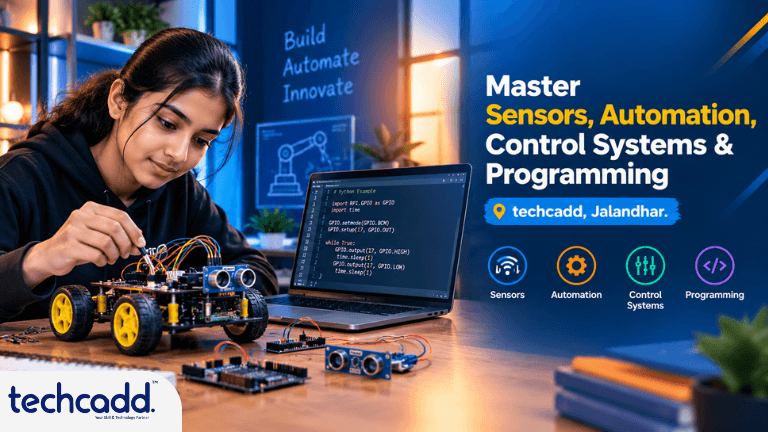
What Does "Advanced Robotics" Actually Mean?
If you've been learning robotics for a while and keep hearing the term "advanced robotics" thrown around, you're probably wondering what separates it from the basics. Here's the honest answer: basic robotics teaches you how a robot moves. Advanced robotics teaches you how a robot thinks, senses and reacts.
At the foundational level, students usually learn how to wire a motor, write a simple program to make a wheel turn, or build a small robot that follows a line on the floor. That's a great starting point, but real-world robots — the ones used in factories, warehouses, hospitals, and even agriculture — need to do a lot more than follow a line. They need to sense their environment, make decisions in real time, and adjust their behavior based on what's happening around them.
That's exactly where sensors, automation, control systems and programming come together.
The Four Pillars of Advanced Robotics
Think of advanced robotics as a four-legged table. Remove one leg, and the whole thing becomes unstable.
Sensors — these are the "senses" of a robot. Cameras, ultrasonic sensors, infrared sensors, gyroscopes, and proximity sensors all feed information to the robot about its surroundings.
Automation — this is what allows a robot to perform tasks without constant human input, repeatedly and reliably.
Control Systems — this is the "brain logic" that decides how the robot should respond to sensor input. Should it slow down? Stop? Turn left?
Programming — this is what ties everything together, giving the robot clear instructions on how to behave in different situations.
A lot of students assume robotics is mostly about mechanical design — building the physical robot. In reality, the mechanical body is often the easiest part. The real challenge, and the real skill employers look for, lies in making that body smart.
In the next part, we'll break down each of these four pillars individually, so you understand exactly how they work and how they connect.
Sensors: How Robots "Feel" the World Around Them
Sensors are often the most underrated part of robotics when students start out, but once you dig deeper, you realize they're actually the foundation of everything else.
A robot without sensors is basically moving blind. It can be programmed to move forward for five seconds, but it has no idea if there's a wall, a person, or a drop in front of it. That's where sensors step in.
Ultrasonic sensors help robots detect obstacles by measuring distance using sound waves — commonly used in robots that need to avoid collisions.
Infrared (IR) sensors are great for line-following robots or detecting objects at short range.
Cameras and vision sensors allow robots to recognize shapes, colors, and even objects, which is now a huge part of modern robotics and AI integration.
Gyroscopes and accelerometers help robots understand their own orientation and balance, which is essential for drones and humanoid robots.
A common doubt students have here is, "Do I need to understand the deep physics behind these sensors?" Not really. What matters more is understanding how to read the data from a sensor and use it meaningfully in your program. The physics helps, but practical implementation is what gets you job-ready.
Automation: Making Robots Work Without Constant Supervision
Automation is where robotics starts feeling less like a "project" and more like a real industrial solution. Automation simply means designing a system where the robot performs repetitive tasks reliably, consistently, and without needing someone to manually control every step.
Think of an automated robotic arm on an assembly line. Once it's set up correctly, it doesn't need a person pressing buttons for every single movement — it follows a programmed sequence, often adjusting based on sensor feedback.
For students, this is usually where things get exciting, because automation is what makes robotics genuinely useful in the real world, whether it's in manufacturing, agriculture, logistics, or even home automation projects.
Control Systems: The Decision-Making Brain of a Robot
If sensors are the eyes and ears of a robot, control systems are the brain that decides what to do with all that information. This is the part where many students initially feel a bit intimidated, mostly because terms like "feedback loop" or "PID controller" sound complicated on paper. In practice, the concept is simpler than it sounds.
A control system basically takes sensor input, compares it to what the robot is supposed to be doing, and then makes a correction. For example, if a self-balancing robot starts tilting, the control system detects this through the gyroscope and instantly adjusts the motor speed to bring it back to balance. This constant cycle of sensing, comparing, and correcting is called a feedback loop, and it's at the heart of almost every advanced robotic system.
A common beginner mistake here is trying to memorize control theory formulas without actually testing them on a real or simulated robot. Control systems genuinely make sense only when you see them working — when you watch a robot wobble, correct itself, and stabilize in real time.
Programming: Tying Everything Together
Programming is the language that connects sensors, automation, and control systems into one functioning robot. Without it, you just have separate hardware components that don't know how to talk to each other.
Languages like Python and C++ are widely used in robotics, along with platforms like Arduino and ROS (Robot Operating System) for more advanced projects. A question students often ask is, "Do I need to be an expert coder before starting robotics?" Not at all. You build programming skills gradually, alongside hardware experimentation, and that combination is what makes learning robotics genuinely enjoyable rather than overwhelming.
For students who want to develop these skills in a structured and practical environment, techcadd's Robotics Course in Jalandhar provides an opportunity to learn programming alongside electronics, sensors, automation, and hands-on robotics projects. This integrated approach helps students understand not just how to write code, but how that code actually controls and communicates with a physical robotic system.
Mastering these four pillars together — not in isolation — is what transforms a hobbyist into someone genuinely capable of building functional, intelligent robotic systems. With the right guidance and consistent hands-on practice, techcadd's Robotics Course in Jalandhar can help students take that journey from learning the basics to building and experimenting with real-world robotics projects.
Filed under
Keep reading
- How to Start Coding from Scratch? A Beginner's Guide in JalandharNew to coding and don't know where to begin? This beginner's guide breaks down the basics, best first languages, and practical steps to start your coding journey in Jalandhar — no prior experience needed.
- Best Coding Practices for Building Real-World Applications: A Student's Guide from techcadd, JalandharLearn the coding practices that actually matter when building real-world apps — from clean code habits to debugging smarter. A practical guide for students in Jalandhar starting their dev journey with techcadd
- Advanced C Programming Concepts: Pointers, Memory & File Handling Explained for Jalandhar StudentsStruggling with pointers, dynamic memory, or file handling in C? This guide breaks down advanced C programming concepts in a simple, practical way for students in Jalandhar starting their coding journey.
Comments
Loading…