On this page
- Why Industrial Training Is Important for B.Tech Students in 2026
- The Classroom-Industry Gap Is Still Real
- It’s Not Just About the Certificate
- What Recruiters Are Actually Looking For in 2026
- Common Doubts Students Have (And Should Ask About)
- Why Location Matters More Than You’d Think
- Making Industrial Training Actually Count in 2026
- The Real Takeaway
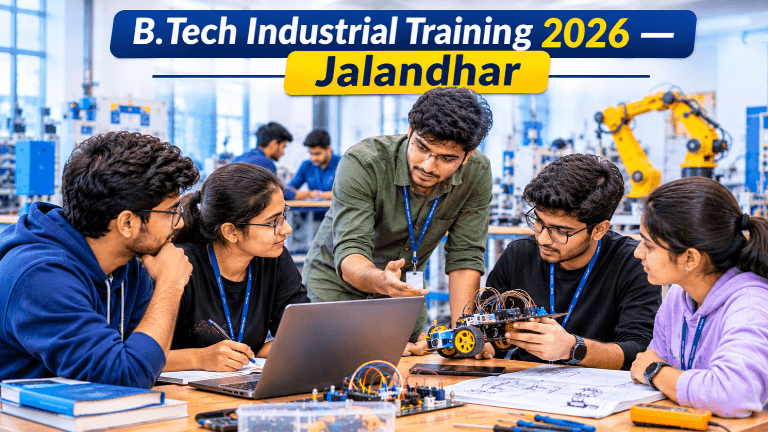
Why Industrial Training Is Important for B.Tech Students in 2026
Ask any final-year B.Tech student what scares them most, and it’s rarely the exams. It’s the placement season. You can have a solid CGPA and still freeze up in an interview when someone asks, “What have you actually built?”
That’s the gap industrial training is meant to close.
For years, industrial training was treated like a formality — something to finish, get a certificate for, and forget. But if you’re a B.Tech student in Jalandhar heading into 2026, that mindset can cost you. Companies today aren’t just hiring degrees. They’re hiring people who can walk in and contribute from day one, or at least show they understand how real projects work outside a textbook.
The Classroom-Industry Gap Is Still Real
Most engineering syllabi move slower than the industry they’re preparing you for. You might be studying a concept in your 5th semester that the industry already considers basic knowledge, while newer tools and practices barely get a mention. Industrial training is where that gap gets filled — not through more theory, but through actual exposure to how projects are planned, built, tested, and shipped.
This is especially true for students in core branches like Mechanical, Electrical, or Civil, where lab work often can’t replicate the scale or pressure of a live industrial environment. Even CSE and IT students, who assume their coding skills are “enough,” often realize during training that writing clean code and working in a real development workflow are two very different skills.
It’s Not Just About the Certificate
A lot of students approach training like a checkbox — attend minimum days, get the signature, move on. But the ones who actually benefit are the ones who ask questions, make mistakes in a low-stakes setting, and absorb how professionals actually solve problems.
That difference shows up later — in interviews, in confidence, and in how quickly you adapt to your first job.
What Recruiters Are Actually Looking For in 2026
Here’s something most students don’t hear clearly enough: recruiters aren’t impressed by the name of the company you trained at. They’re impressed by what you can explain about what you did there.
If you can walk into an interview and talk through a real project — what problem it solved, what tools you used, what went wrong and how you fixed it — that carries far more weight than a generic training certificate. In 2026, with AI tools, automation, and faster development cycles reshaping almost every industry, companies are specifically looking for students who’ve had some contact with current, relevant tools and workflows, not just classroom theory from three years ago.
This is where choosing the right training matters as much as doing it at all. Training that mirrors live industry projects — not just recorded lectures or outdated modules — gives you something real to talk about later.
Common Doubts Students Have (And Should Ask About)
A few questions come up again and again when students think about industrial training:
“Is six weeks or six months really enough to learn anything?”
It depends less on duration and more on whether the training is hands-on. A focused few weeks of actually building something will teach you more than months of passive observation.
“I’m not from a CS background — will this still help me?”
Yes. Mechanical, Electrical, and Civil students often need industrial exposure even more, since lab setups rarely replicate real site or production conditions.
“What if I don’t know where to start?”
Start with your core branch’s current industry trends, then look for training that’s project-based rather than purely theoretical.
Why Location Matters More Than You’d Think
For students based in and around Ludhiana, choosing training that’s accessible without long commutes or relocation stress makes a real difference. It means more consistency, less fatigue, and more energy actually spent learning — not travelling.
Making Industrial Training Actually Count in 2026
So how do you make sure your industrial training is worth the time and not just another line on your resume?
Start by being honest about your goal. If you’re treating it as a formality, you’ll get a formality’s worth of value. If you go in wanting to build something real — even something small and imperfect — you’ll walk out with stories, skills, and proof of work that actually mean something in an interview.
A few things worth keeping in mind as you pick or begin your training:
Choose project-based over lecture-based. If the training is mostly slides and recorded sessions, you’re not getting industrial exposure — you’re getting a longer classroom. Look for programs where you’re actually building, debugging, and troubleshooting.
Don’t ignore the “boring” parts. Documentation, version control, testing — students often skip past these in college. But these are exactly the habits that separate someone who can work independently from someone who needs constant supervision.
Ask what you’ll be able to show afterward. A certificate is fine, but a working project, a GitHub repo, or something you can demo is what actually gets remembered by recruiters.
Talk to seniors who’ve already done it. Not all training programs are equal. Someone who went through it last year can tell you far more than any brochure.
The Real Takeaway
Industrial training isn’t about adding another certificate to your resume pile. It’s about closing the distance between “I studied this” and “I can actually do this.” In 2026, with industries moving faster and expecting graduates to adapt quickly, that distance is exactly what separates students who struggle in interviews from those who walk in with something real to say.
If you’re a B.Tech student in Jalandhar figuring out your next move, don’t wait until placement season to think about this. The earlier you get real exposure, the more confident — and prepared — you’ll actually be.
Filed under
Keep reading
- How Industrial Training in Jalandhar Helps B.Tech Students Prepare for Technical JobsGood marks alone rarely land technical jobs. Learn how industrial training in Jalandhar helps B.Tech students build real skills, work on live projects and feel job-ready, with practical guidance from techcadd.
- Full Stack React Development: Building Modern Web Applications Through Industrial Training in JalandharWant to build real web apps, not just follow tutorials? Learn how industrial training in Full Stack React Development at techcadd in Jalandhar helps students turn coding basics into job-ready skills.
- Advanced Robotics in Jalandhar: Sensors, Automation, Control Systems & Programming ExplainedWant to master advanced robotics? Learn how sensors, automation, control systems and programming work together, and where to build these skills in Jalandhar.
Comments
Loading…