On this page
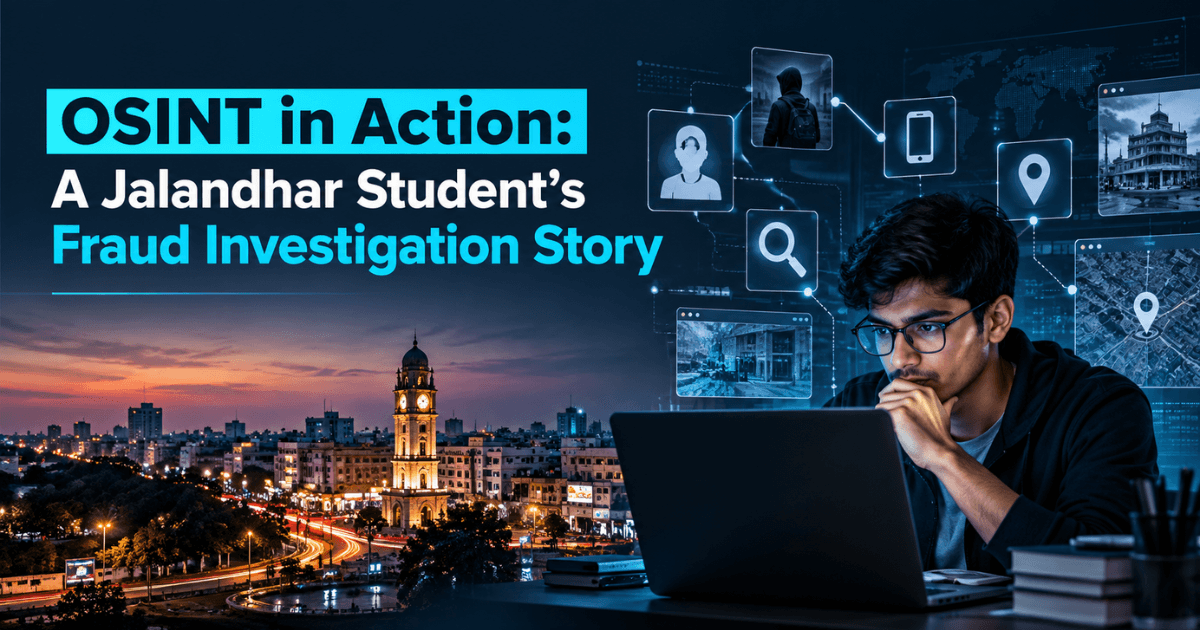
When a College Project Turned Into Real Detective Work
Rahul was sitting in his final year of college, scrolling through fraud complaint groups on Facebook (yes, those exist, and yes, they're full of chaos) when something caught his eye. A local shopkeeper in his neighborhood had been scammed out of nearly ₹40,000 by someone posing as a wholesale supplier online. The police had a few screenshots, a phone number, and not much else to go on.
Most people would've scrolled past. Rahul didn't.
He'd been learning OSINT — Open Source Intelligence — for about four months at that point, mostly out of curiosity. He wasn't trying to be a hero. He just wanted to see if the skills he'd been practicing on dummy exercises actually worked in the real world.
So he started digging. Not hacking, not anything illegal — just piecing together publicly available information the way OSINT actually works. A username reused across platforms. A profile photo that showed up on a dating app under a different name. A phone number linked to an old Justdial listing from 2019. Small details that, on their own, meant nothing. Together, they painted a picture.
Within two days, Rahul had traced the scammer's digital footprint to a real identity and a rough location. He handed everything over to the shopkeeper, who passed it to the local cyber cell. The case moved forward from there — something that felt stuck for weeks suddenly had direction.
Here's the part that usually surprises people: Rahul isn't a cybersecurity expert. He's a regular student who got curious about how online investigations actually work, and decided to learn it properly instead of just watching true-crime videos about it.
What Exactly Is OSINT, and Why Should Students Care?
OSINT stands for Open Source Intelligence — the practice of collecting and analyzing information that's already public. Social media posts, old forum comments, metadata in photos, domain registration records, even Google Maps reviews. None of it is hidden or hacked. It's just scattered, and OSINT is the skill of connecting the scattered pieces into something useful.
If you're a student wondering whether this is "too technical" or "only for ex-hackers," it's really not. A lot of what Rahul used didn't require fancy tools. It required patience, curiosity, and knowing where to look — which is exactly what a structured course teaches you, instead of leaving you to figure it out through random YouTube videos.
This is also where a lot of students get surprised about career options. OSINT isn't just a "cybersecurity thing" anymore. It's used by:
Cyber cells and law enforcement for digital investigations
Corporate fraud and risk teams doing background checks
Journalists verifying sources and tracing misinformation
Private companies doing due diligence before big deals
Cybersecurity teams during the reconnaissance phase of security assessments
For students in and around Jalandhar looking at where the tech job market is actually heading, this matters. Punjab's cyber cells and local businesses are dealing with a rising number of fraud cases — fake job offers, UPI scams, fake supplier calls — and most of them are desperately short on people who know how to investigate digitally.
A common doubt students raise at this point: "Do I need a coding background for this?" Not really. Basic computer literacy and a genuinely curious mindset matter more than knowing Python on day one. The technical depth comes later, once the fundamentals click.
Getting Started with OSINT the Right Way
If Rahul's story got you even a little interested, here's the honest part: don't start by trying to "solve a case." Start by building the fundamentals properly, because that's what actually separates a hobbyist from someone who can be trusted with real investigative work.
A good starting path usually looks like this:
Understand the basics of digital footprints — how information spreads and links across platforms
Learn search techniques that go beyond typing something into Google and hoping for the best
Get familiar with reconnaissance tools used for usernames, images, and metadata
Practice ethics and legality — this is non-negotiable, since the line between OSINT and privacy violation is thinner than people assume
Work on real-world style case studies, not just theory
This is exactly where structured, mentor-led learning makes a difference over self-study. It's easy to watch a few videos and feel like you "get it." It's a different thing entirely to be guided through real exercises, get your mistakes corrected, and understand why certain techniques work and others don't.
A common beginner mistake is jumping straight into tools without understanding the thinking behind OSINT. Tools change. The investigative mindset — asking the right questions, verifying before concluding, staying ethical — doesn't.
For students, this skill doesn't just open doors into cybersecurity. It builds an analytical, detail-oriented way of thinking that's genuinely useful in almost any tech career. Rahul didn't set out to help solve a fraud case. He set out to learn something new, properly, and the opportunity found him because he was prepared for it.
That's really the takeaway here — not that you need to go looking for a case to crack, but that building real skills quietly, consistently, puts you in a position where you can actually make a difference when it matters.
Getting Started with OSINT the Right Way
If Rahul's story got you even a little interested, here's the honest part: don't start by trying to "solve a case." Start by building the fundamentals properly, because that's what actually separates a hobbyist from someone who can be trusted with real investigative work.
A good starting path usually looks like this:
Understand the basics of digital footprints — how information spreads and links across platforms
Learn search techniques that go beyond typing something into Google and hoping for the best
Get familiar with reconnaissance tools used for usernames, images, and metadata
Practice ethics and legality — this is non-negotiable, since the line between OSINT and privacy violation is thinner than people assume
Work on real-world style case studies, not just theory
This is exactly where structured, mentor-led learning makes a difference over self-study. It's easy to watch a few videos and feel like you "get it." It's a different thing entirely to be guided through real exercises, get your mistakes corrected, and understand why certain techniques work and others don't.
A common beginner mistake is jumping straight into tools without understanding the thinking behind OSINT. Tools change. The investigative mindset — asking the right questions, verifying before concluding, staying ethical — doesn't.
For students, this skill doesn't just open doors into cybersecurity. It builds an analytical, detail-oriented way of thinking that's genuinely useful in almost any tech career. Rahul didn't set out to help solve a fraud case. He set out to learn something new, properly, and the opportunity found him because he was prepared for it.
That's really the takeaway here — not that you need to go looking for a case to crack, but that building real skills quietly, consistently, puts you in a position where you can actually make a difference when it matters.
Filed under
Keep reading
- : What Is OSINT? How Open-Source Intelligence WorksOSINT (Open-Source Intelligence) means gathering public data for cybersecurity and research. Learn what OSINT is, how it works, and why it matters for students in Jalandhar.
- The Jalandhar Teenager Who Found a Security Flaw in a Local Business WebsiteA Jalandhar teen spotted a security flaw in a local business website — a real story showing why ethical hacking and cybersecurity skills matter for students today.
- Passwords vs. Passkeys: Which Is More Secure? A Jalandhar Student's GuidePasswords or passkeys — which one actually keeps your accounts safe? techcadd breaks down the real differences so Jalandhar students can browse, study and work online with confidence.
Comments
Loading…