A skill-development and IT training partner near Doaba College in Jalandhar, Punjab.
Near Doaba College
Jalandhar
techcadd
Skill and Technology Partner
Career Counselling
Technology Awareness
Skill Development
Internships & Placements
Learn Today, Lead Tomorrow.
Institution
Near Doaba College
Location
Jalandhar
Focus
Skill Development · IT Training · Student Guide
Jalandhar
techcadd Jalandhar operates as a prominent skill-development and IT training partner near Doaba College in Jalandhar, Punjab.
For a student at a college in Jalandhar, a nearby training institute can make it easier to add practical skills alongside regular classes. Travel time matters, and so does the ability to attend short evening, weekend or holiday sessions without disrupting college work. Location is therefore a real consideration when choosing where to train.
This article describes the location statement as it was supplied and then offers general guidance on choosing and using IT training. The exercises and explanations that follow are additional educational guidance. They do not describe any programme run jointly with Doaba College.
What the statement says, and what it does not
The supplied statement says two things: techcadd Jalandhar is a skill-development and IT training provider, and it is located near Doaba College in Jalandhar. “Near” describes geography. It does not mean that the institute is part of the college, that the college recommends it or that the two work together.
This distinction protects students and families. If you want to know whether a course carries academic credit, whether the college recognises a certificate or whether any joint programme exists, ask Doaba College directly. If you want to know the course content, fees and timings, ask techcadd. Keep any answers in writing.
The statement does not give the exact address, distance, course list, fees or batch timings. Check the official techcadd Jalandhar page, and use a map to confirm the route from your college.
Technology pathways in brief
Students may explore software and web development, artificial intelligence and machine learning, data analytics, digital design, cloud computing, cybersecurity, networking and office or accounting software. These are examples of possible pathways, not a list of courses offered by techcadd Jalandhar. Each needs different foundations:
Software rolesRest on programming and testing.
Data rolesRest on statistics and careful interpretation.
Design rolesRest on visual thinking and tool fluency.
Test a field before committing
Instead of choosing a field because it is popular, a student can read genuine entry-level job descriptions, list the skills they ask for and build one small project in the area. The aim is to test interest and gather evidence of ability before committing time and money.
Choosing a training institute near your college
Proximity is useful, but it should not be the only factor. Compare at least two options, and be wary of any promise of guaranteed jobs.
Visit the institute if you can.
Ask for a written course outline with topics, hours, practical tasks, assessment and the outcome you will receive.
Ask who teaches and how large the batches are.
Ask whether you can attend a demonstration class.
Read genuine entry-level job descriptions to check that the course teaches skills employers request.
Fitting training around college
Plan your timetable before you enrol. Identify the free hours you have each week, and choose batches that do not clash with classes, labs or exams. A smaller, steady commitment is usually better than an intensive schedule you cannot keep up.
Tell your teachers what you are doing. They can sometimes suggest relevant topics, project ideas or ways to connect your training with coursework.
Turning short courses into evidence
A certificate shows that you attended or completed a course. It does not prove that you worked in a real setting. Finish each course with something you can show: a working project, a design file or a short analysis, together with notes on what went wrong and what you would change.
Describe your training accurately on a CV, including its length and what you actually built.
Why career awareness matters
Career awareness is not a promise of employment. It is a way to understand the available choices before committing to a path. A good session helps a student ask what problems they enjoy solving, which skills they already have and which gaps they should close first.
A simple exercise is to compare three roles by daily tasks, required skills and the evidence an employer would want to see. Write down what you find, then discuss it with a teacher or a practitioner. Treat the exercise as a starting point, and repeat it as your skills develop.
Getting value from technical workshops
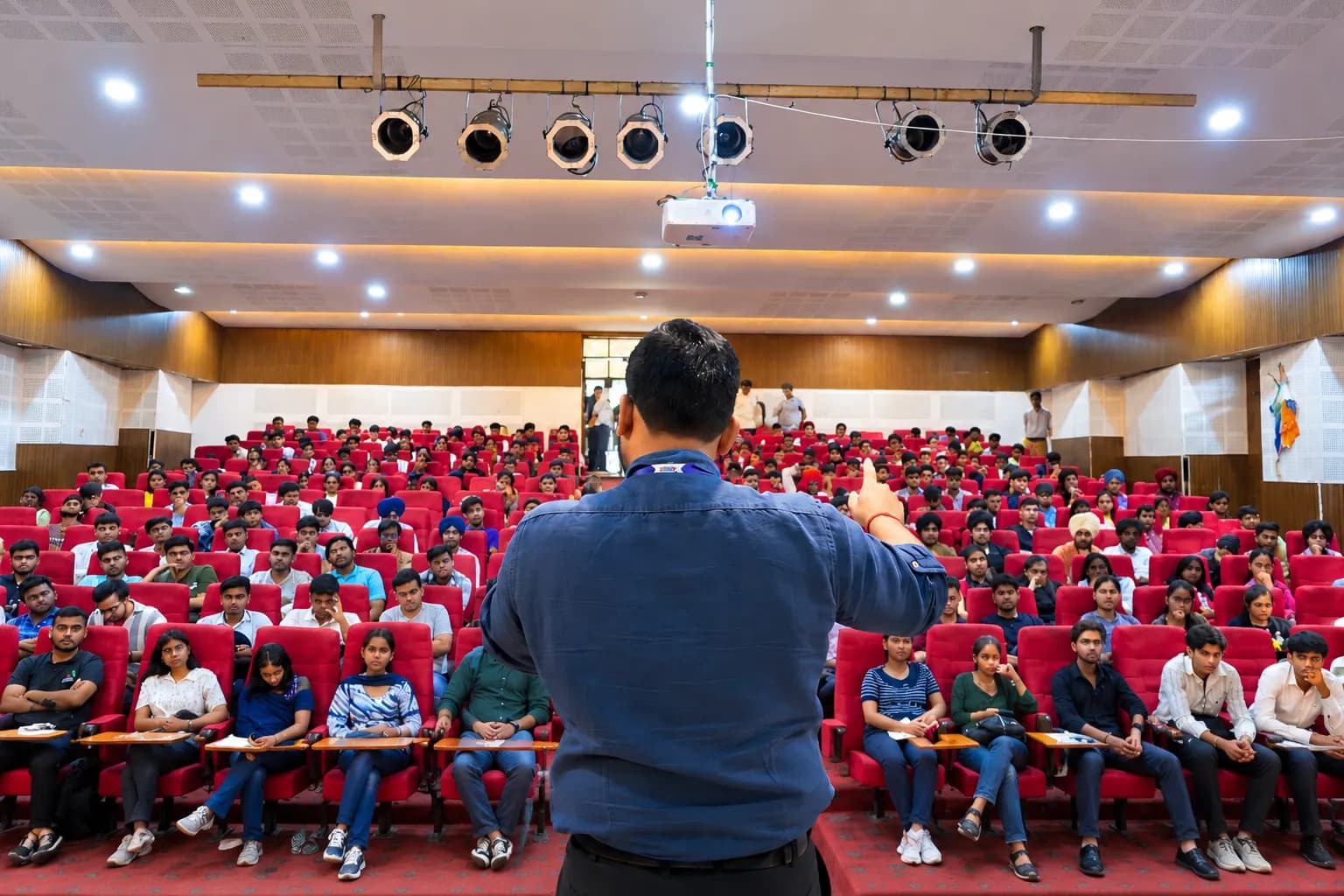
A workshop is most useful when you arrive prepared and leave with something you can build on. Before attending, find out the topic and install any tools in advance, so that workshop time goes to learning rather than setup. During the session, work on the exercises yourself instead of only watching.
Afterwards, repeat the main exercise on your own within a few days and change one thing, such as the data, the design or the requirement. Skills that are not practised soon after a workshop tend to fade. A short note describing what you built, what went wrong and what you would try next makes a good start for a portfolio entry.
What industrial exposure can and cannot do
Industrial exposure shows how tools and processes work in real settings: how projects are planned, how teams review work, and what quality and safety standards apply. It is valuable for seeing the difference between producing a correct answer in class and delivering a dependable result at work.
Be clear about its limits. A visit, a short training or a guest demonstration is not the same as a supervised internship or employment. When listing such experience on a CV, describe it accurately and say what you actually did.
Bridging academic knowledge and workplace practice
Coursework tends to reward individual correctness. Workplaces also reward collaboration, documentation, version control and delivery on time. Students can build these habits early by putting an assignment in a repository, writing a short README and noting the problems they hit and how they fixed them.
Ask a classmate to run your project from your instructions alone. Every point where they get stuck shows a gap in your documentation. Fixing those gaps teaches more about professional practice than adding another feature.
Building a realistic skill roadmap
A roadmap sequences foundations, practice, feedback and harder work. Choose a role to explore, then work backwards: which fundamentals does it need, which tools are common and what could you build to show competence?
A twelve-week plan with one concept, one exercise and one small deliverable each week suits many students. Avoid starting several unrelated technologies at once. Depth in one area, with honest notes on what is still unclear, is more convincing than a long list of tools.
Choosing between workshops, courses and internships
They are different, and treating them as interchangeable leads to disappointment.
WorkshopIntroduces a topic in hours or days.
CourseStructures learning over weeks or months.
InternshipPlaces you in real work under supervision.
Before you enrol
Ask for a written outline of topics, hours, practical tasks, assessment and outcomes. For internships, ask what work you will do, who will mentor you and how you will be evaluated. A certificate alone does not prove that workplace experience took place.
What makes a credible student project
A credible project has a clear problem, a transparent method, some testing and an honest account of its limits. It need not be large. A small, well-explained project, such as a design model, a simple web application or a dashboard built from public data, can show more thinking than a copied tutorial.
Write a README covering the goal, how to run the project, the tools used, screenshots and known issues. If you followed a tutorial, say so and explain what you changed yourself.
Developing a public portfolio
A portfolio shows your reasoning as well as your results. Two or three carefully explained projects are better than ten unfinished ones. For each, describe the problem, your approach, what went wrong and what you would do next.
Use only data, images and models you have permission to share, respect software licences and never publish confidential information. For team projects, state clearly which parts you built.
Communication skills for technical roles
Engineers regularly explain trade-offs to people who do not share their background. Clear communication is part of technical competence.
Practise a one-minute spoken overview and a one-page written note for one project. Cover the problem, your approach, the result and the limits. Ask someone outside your field to read it, and simplify anything they cannot explain back to you.
Preparing for internships and entry-level interviews
Internship preparation starts with sound foundations, a focused CV and a realistic understanding of the role. Choose a small number of genuine opportunities and match each skill you claim to a piece of evidence, such as a project or assignment. Avoid exaggerated claims and generic mass applications.
Interviews often test fundamentals, projects and communication. Be ready to explain one project decision in detail and one problem that took real debugging to solve. Memorised answers rarely survive a follow-up question, and it is acceptable to say you do not know something and explain how you would find out.
Career planning by year of study
First year: explore. Try one short activity each in software, design and data, and notice which one you keep returning to.
Second year: choose a track and complete one small end-to-end project in it.
Later years: deepen that work, seek supervised experience and prepare applications.
At every stage, measure progress by what you have learned and not by comparison with classmates.
Conclusion
techcadd Jalandhar, located near Doaba College, offers local students a convenient place to build IT and technical skills. Students gain the most when they choose a course with care, fit it around college, keep honest records of their work and finish with a project they can explain. Steady practice and clear communication remain the foundations of a sound technology career.
“Proximity is useful, but it shouldn’t be the only factor.”
Is techcadd Jalandhar a partner of Doaba College?+
The supplied statement does not say so. It says only that techcadd Jalandhar is located near Doaba College. Ask the college whether any formal arrangement exists.
What courses does techcadd Jalandhar offer?+
The supplied information does not list courses. Check the official techcadd Jalandhar page for current courses, fees and timings.
Does training near a college help with placement?+
Nothing in the supplied information says so. Location can help with convenience. Outcomes depend on the skills you build and what employers need.