On this page
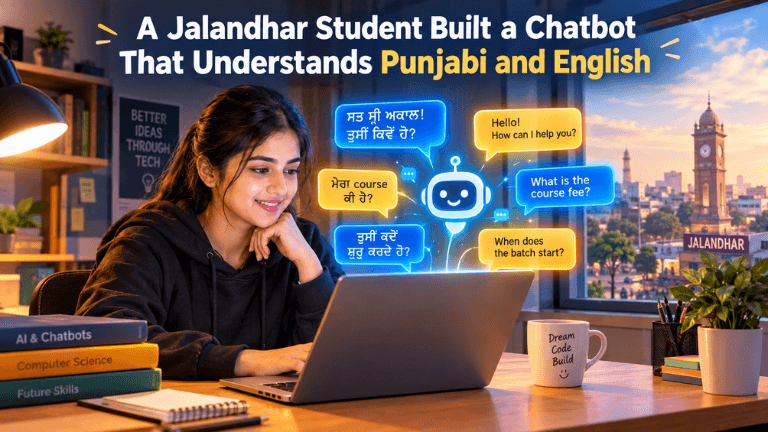
A Chatbot That Actually Gets Punjabi
There's a moment every student who's played around with AI chatbots knows well. You type a question in Punjabi, or even mix it with English the way most of us actually talk, and the bot just... doesn't get it. It replies in stiff, formal English, or worse, it completely misreads what you meant.
That's the exact frustration that pushed a student from Jalandhar to build something different — a chatbot that understands both Punjabi and English, the way people here actually speak.
It started as a small side project, not some big official assignment. The idea was simple: why should local users have to translate their thoughts into "proper" English just to get a decent answer from a chatbot? Punjabi isn't just a language spoken at home — it's how a huge number of people in this region think, joke, ask for help, and explain problems. A chatbot that ignores that is missing half the conversation.
Building it wasn't a one-weekend job. The student had to think through some real technical questions. How do you handle Punjunjabi written in English letters (the way most people text)? How do you make sure the bot doesn't just translate word-for-word and lose the meaning? How do you keep replies natural instead of robotic?
If you're a student reading this and thinking, "I could never build something like that," here's the truth — this project didn't start with advanced skills. It started with curiosity, a clear problem to solve, and a willingness to learn the tools step by step. That's a mindset more useful than any single course.
In Part 2, we'll get into how the chatbot was actually built — the tools, the language models, and the trial-and-error that went into making it work.
Behind the Scenes: How the Chatbot Was Actually Built
Once the idea was clear, the real work started — and it wasn't glamorous. Before writing a single line of code, the student spent time just collecting examples of how people in Jalandhar actually text and talk. Punjabi written in Roman script, mixed with English words mid-sentence, casual short forms — this "real" data mattered more than any textbook example.
For the actual build, the project relied on natural language processing (NLP) techniques and pre-trained language models, fine-tuned to recognize Punjabi phrases alongside English ones. Instead of building a language model completely from scratch (which would take far more resources than a student project usually has access to), the smarter move was adapting existing open-source tools and training them further on local language patterns.
This is actually a really important lesson for anyone starting out in AI or tech: you don't always need to reinvent everything. Knowing which existing tools to use, and how to customize them for your specific problem, is a skill in itself.
Of course, it wasn't smooth the whole way. Early versions of the chatbot kept mixing up similar-sounding Punjabi words, or defaulting back to English when a sentence got even slightly complex. There were points where the responses came out almost funny — technically correct but completely missing the tone or intent behind the question.
Debugging this kind of thing isn't like fixing a syntax error. It meant going back, testing with real conversations, tweaking the training data, and testing again. Patience mattered just as much as technical know-how.
By the time the chatbot reached a stable version, it could handle everyday queries — class doubts, general questions, even casual chit-chat — switching naturally between Punjabi and English depending on how the user typed.
In Part 3, we'll look at why this project matters beyond just being a cool build, and what it means for students who want to try something similar.
Why This Project Matters — And What Students Can Learn From It
That's really the takeaway here. Good tech projects rarely come from having all the answers upfront. They come from picking a real problem — in this case, a language gap most people just accepted — and being willing to sit with the messy, frustrating process of actually solving it.
If a chatbot that understands Punjabi and English can come out of a student project in Jalandhar, it's worth asking what problem you might be able to solve too.
And if you're ready to turn that curiosity into practical skills, join techcadd's NLP course in Jalandhar Learn the fundamentals of Natural Language Processing, understand how language models work, and get hands-on experience through practical projects.
Don't just learn AI concepts — build with them, experiment, test, and solve real-world problems. Join techcadd's NLP course and start working on practical projects that turn your ideas into something real.
Filed under
Keep reading
- From Classroom Project to Play Store: An App Development Success Story in JalandharHow a simple classroom assignment in Jalandhar turned into a real Play Store app — a practical, inspiring look at what it actually takes for students to go from idea to launch.
- How Ethical Hacking Training Turned a Curious Mind Into a Cyber Professional in JalandharFrom curious beginner to confident cyber professional — discover how ethical hacking training in Jalandhar helped one student build real skills, land opportunities, and start a career in cybersecurity.
- The Jalandhar Teenager Who Found a Security Flaw in a Local Business WebsiteA Jalandhar teen spotted a security flaw in a local business website — a real story showing why ethical hacking and cybersecurity skills matter for students today.
Comments
Loading…