On this page
- What Is Robotics, Really?
- Why Robotics Matters Today
- The Three Core Pillars of Robotics
- Is Robotics Hard to Learn?
- Do You Need Coding Experience First?
- What Do Beginners Usually Get Wrong?
- What Does a Beginner's Learning Path Look Like?
- What Can You Do After Learning Robotics?
- Will This Skill Actually Help Your Career?
- Getting Started the Right Way
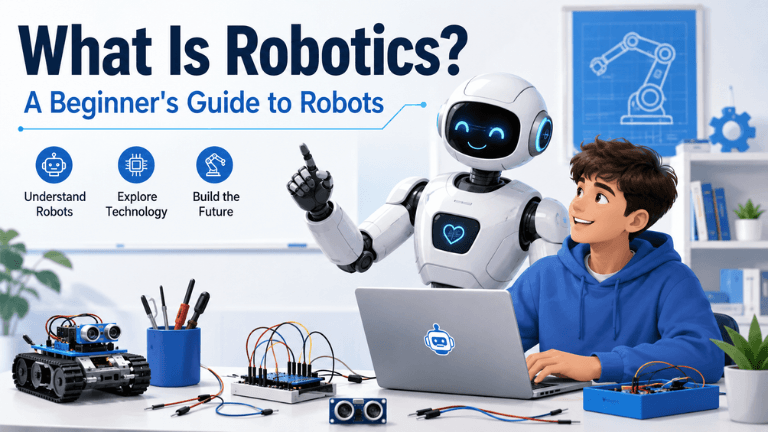
What Is Robotics, Really?
Let's start with something simple. Picture a robot. What comes to mind? Maybe a metal arm welding a car, or a vacuum cleaner that zips around your living room on its own, or even a sci-fi character from a movie. All of these are robotics in action, just in very different forms.
In the simplest terms, robotics is the branch of technology that deals with designing, building, and programming machines that can sense their surroundings, make decisions, and perform tasks, often without a human controlling every single move. It sits at the crossroads of mechanical engineering, electronics, and computer science. You need the mechanical part to build the body, the electronics to give it senses and power, and the programming to give it a "brain" that tells it what to do.
Why Robotics Matters Today
Here's the thing most people don't realize until they actually get into it: robotics isn't some futuristic concept anymore. It's already running factories, performing surgeries, delivering packages, exploring Mars, and even helping farmers monitor crops. If you've used a smart home device or seen automated checkout systems, you've already interacted with robotics in some form.
For students, this matters a lot. Industries across manufacturing, healthcare, agriculture, logistics, and defense are actively looking for people who understand how robots work and how to build or maintain them. That demand isn't slowing down.
The Three Core Pillars of Robotics
Every robot, no matter how simple or advanced, is built on three basic pillars:
Sensing – how the robot perceives its environment (cameras, sensors, touch detectors)
Processing – how it "thinks" and decides what to do with that information
Action – how it physically responds, usually through motors, actuators, or wheels
Understanding these three pillars is the first real step toward understanding robotics, whether you're planning to study it seriously or you're just curious about how the technology around you actually works.
Is Robotics Hard to Learn?
This is probably the question every beginner asks first, and honestly, the answer is: it depends on how you approach it. If you try to learn everything at once, mechanical design, circuit building, and advanced programming, you'll probably feel overwhelmed within a week. But if you break it down step by step, robotics becomes a lot more manageable than it looks from the outside.
Most beginners don't need an engineering degree to get started. What you actually need is curiosity, basic problem-solving skills, and the patience to debug things when they don't work the first time (and trust us, they rarely do the first time).
Do You Need Coding Experience First?
A common doubt among students is whether they should learn programming before even touching robotics. The honest answer is no, not necessarily. Many beginner robotics kits and courses teach you coding alongside hands-on building, so you pick up both together. That said, having a little familiarity with basic logic, loops, and conditions (the kind of thing you'd learn in introductory programming) does make the early stages smoother.
What Do Beginners Usually Get Wrong?
A few patterns show up again and again with students who are just starting out:
Jumping straight into complex projects without understanding basic circuits first
Ignoring the mechanical side and focusing only on code
Getting discouraged when a robot doesn't work on the first attempt, which is completely normal
Skipping the "why" behind a concept and just copying tutorials without understanding them
Avoiding these mistakes early on saves a lot of frustration later. Robotics rewards patience and hands-on experimentation far more than memorization.
What Does a Beginner's Learning Path Look Like?
A practical starting point usually looks something like this: understanding basic electronics, getting comfortable with a beginner-friendly programming language, learning how sensors and motors communicate with a controller, and then slowly moving into small projects like line-following robots or simple automation tasks. Each small project builds confidence for the next.
What Can You Do After Learning Robotics?
This is where things get genuinely exciting. Once you have a grip on the fundamentals, robotics opens doors into several directions, and you don't have to pick just one right away.
Some students move toward automation and manufacturing, working with industrial robots used in production lines. Others get drawn into embedded systems and IoT, building smart devices that interact with the physical world. There's also a growing space in drone technology, medical robotics, and agricultural automation, each with its own set of real-world problems worth solving.
If you enjoy building physical things, hardware-focused robotics might suit you. If you're more drawn to logic and software, you might lean toward robotics programming, AI integration, or control systems. The field is broad enough that your interests can genuinely shape your path.
Will This Skill Actually Help Your Career?
Students often ask this, and fairly so, since learning something new is an investment of time and effort. The honest answer is that robotics skills are increasingly valuable because they combine multiple in-demand abilities: problem-solving, technical understanding, and hands-on execution. Even if you don't end up working directly as a robotics engineer, the mindset and technical foundation carry over into fields like automation, electronics, software development, and product design.
Getting Started the Right Way
If you're a student in Jalandhar looking to explore robotics seriously, the best approach is to start small. Get your hands on a basic kit, follow structured lessons instead of random YouTube videos, and don't be afraid to break things while learning — that's genuinely part of the process. Local, guided learning environments can also help a lot, especially when you're stuck and need someone to explain a concept differently than a textbook does.
That's where techcadd's Robotics Course in Jalandhar can be a great place to start. With structured, practical learning and hands-on projects, students can build their understanding step by step while gaining experience with real robotics concepts. Instead of just learning theory, you'll get the opportunity to learn by building, experimenting, troubleshooting, and improving your projects.
Robotics isn't about being a genius with machines from day one. It's about staying curious, building consistently, and learning from every robot that doesn't work quite right the first time.
Ready to start building? Join techcadd's Robotics Course and take your first step towards learning robotics through practical, hands-on experience.
Filed under
Keep reading
- How to Start Learning C Programming as a Beginner? A Complete Guide for Jalandhar StudentsNew to coding? Here's a simple, practical guide for Jalandhar students on how to start learning C programming as a beginner — no prior experience needed, just the right approach.
- Deep Learning Explained: How It Works, Real-World Applications & What's NextConfused about deep learning? This complete guide breaks down how it actually works, where it's used, and why it's a smart skill to learn in Jalandhar right now.
- Top 10 Full Stack Development Institutes in Jalandhar Compared (2026 Guide)Confused about where to learn full stack development in Jalandhar? Here's an honest, student-focused comparison of the top 10 institutes to help you pick the right one for your goals.
Comments
Loading…