Kotlin Android App Development Certificate Program in Jalandhar with Live Projects & Placement Support
Learn native Android development the way product companies actually build it — Kotlin, Jetpack Compose, XML layouts, MVVM architecture and Firebase — and finish with an app published under your own name on the Play Store.
- Live client projects
- Practitioner trainers
- Placement support
- Certificate + internship
- Duration
- 3 Months
- Syllabus
- 6 Modules, 2026 Edition
- Mode
- Classroom, Weekend & 1-on-1
- Includes
- Published Play Store App
- Students trained
- 25,000+Students trainedsince 2016
- Google rating
- 4.9★Google rating556+ reviews
- Practical training
- 100%Practical traininglive client work
Course overview
This Kotlin Android App Development Certificate Program takes you from zero to a published Play Store app. You start with Kotlin fundamentals — variables, null safety, OOP, coroutines — then move into Android Studio, XML layouts and Jetpack Compose for modern UI, and MVVM architecture with ViewModel and StateFlow to structure real apps instead of spaghetti code.
From there you connect to the outside world: Retrofit for REST APIs, Room Database for offline storage, and full Firebase integration — Authentication, Firestore, Cloud Messaging, Crashlytics. If you are coming from a general-purpose language, our Python programme is a common on-ramp before Kotlin. The programme closes with Git and GitHub workflow, testing and debugging, and a capstone app you actually deploy to the Play Store.
Built for Android,useful well beyond it
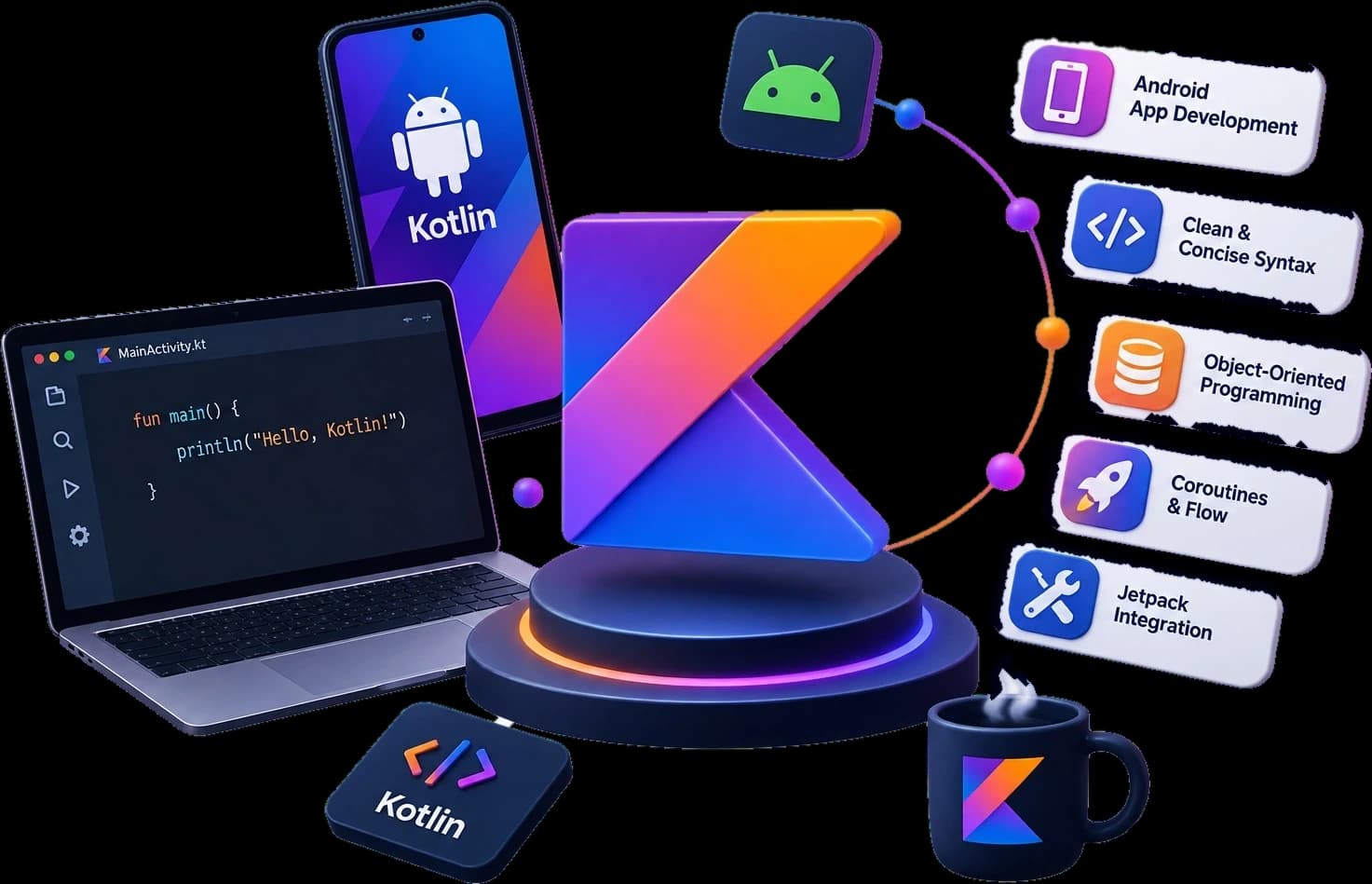
Kotlin is a modern programming language that Google has preferred for Android since 2019. Most new Android apps, and the official Android libraries and samples, are written in it. It runs on the same platform as Java (the JVM), so it can also be used for server software, and with Kotlin Multiplatform it can share code with iPhone apps.
Think of Kotlin as the language and Android as the workplace. You can know Hindi well and still need to learn how a bank or a hospital works before you can do a job there. This course teaches both: Kotlin from zero, then the Android tools you build real apps with, such as Android Studio, Jetpack Compose, ViewModel and coroutines, ending with an app published on the Play Store. Each field below shows how much of it this course covers.
- Job-ready focus2 fields
- The course trains you for entry-level work in this field.
- Strong foundation1 field
- You learn the base skills here; one specialised course makes you job-ready.
- Introduced1 field
- You will use it in the course, but it is not a specialisation.
- Not covered1 field
- Not part of this course; available as a separate techcadd course.
What this course makes you job-ready for
Job-ready focusNative Android App Development
Building apps that run directly on Android phones using Google's own tools, with full access to the camera, notifications, location and offline storage. Native apps are what most product companies and many agencies build for Android.
A food-ordering app for a Jalandhar restaurant chain that shows the menu, saves your cart even when the internet drops, takes the order and sends a notification when it is out for delivery.
- Kotlin tools used
- KotlinAndroid StudioJetpack ComposeViewModelCoroutinesRetrofitRoomFirebase
- Job roles
- Android DeveloperKotlin DeveloperMobile App DeveloperJunior Software Engineer (Android)
All six modules, from Kotlin fundamentals to the production-signed capstone. Projects: E-Commerce, Food Delivery, Chat, Expense Tracker and News apps, and the Live Client Android App published on the Play Store.
Android UI Development
Designing and building the screens people actually tap: layouts, buttons, forms, navigation, themes and animations that feel right on phones and tablets.
Turning a designer's screens for a Punjab bank's loan-enquiry app into a working interface with validated forms and smooth transitions.
- Kotlin tools used
- Jetpack ComposeMaterial Design 3XML layoutsNavigation Compose
- Job roles
- Android UI DeveloperAndroid Developer
Android Fundamentals (XML layouts with ConstraintLayout and LinearLayout) and Jetpack Compose UI Development (Material 3, reusable composables, adaptive layouts, navigation, forms and animations).
What this course lays the foundation for
Strong foundationServer-side & Backend Kotlin
Using Kotlin to write the backend of an app or website: the server that stores data, checks logins and sends results to phones. Kotlin works with Java's Spring Boot framework and with Kotlin-native frameworks such as Ktor.
The server that stores every order from the food-ordering app above and sends it to the restaurant's kitchen screen.
- Kotlin tools used
- KtorSpring BootPostgreSQLREST APIs
- Job roles
- Backend Developer (Kotlin)Kotlin Developer
The Kotlin language, OOP, collections, null safety and coroutines (Modules 1 and 5) are the same on the server. In the projects your apps call REST APIs and use Firebase as a ready-made backend, but building your own server is not taught in this course.
What this course introduces
IntroducedMobile Testing & Release Quality
Making sure an app works on real devices before and after release: testing, catching crashes and preparing safe releases.
Spotting through crash reports that an app closes on one brand of phone when the camera opens, and fixing it before the ratings drop.
- Kotlin tools used
- Firebase CrashlyticsAndroid Studio debuggerbuild variants
- Job roles
- Android DeveloperMobile QA Engineer
Testing and debugging, crash reporting, build variants and release preparation are covered in the capstone module. A dedicated mobile testing or QA specialisation is not part of this course.
Not part of this course
Not coverediOS & Cross-Platform Apps
Building apps that also run on iPhones, either natively in Swift, from one shared codebase with Flutter, or by sharing Kotlin code across platforms with Kotlin Multiplatform.
A Jalandhar coaching institute wanting the same student app on both Android phones and iPhones.
- Kotlin tools used
- FlutterDartKotlin MultiplatformSwiftXcode
- Job roles
- Flutter DeveloperCross-Platform App DeveloperiOS Developer
Not part of this course, which is Android only. Cross-platform development for Android and iOS from one codebase is taught in techcadd's Flutter App Development course.
Clearing up common confusions
Is this a Kotlin course or an Android course?
Both, in that order. The first module teaches the Kotlin language on its own; every module after it uses Kotlin to build Android apps. The course does not cover the other places Kotlin is used, such as server software.
XML layouts or Jetpack Compose?
Both are used in real jobs. Jetpack Compose is the modern way Google recommends for new screens; XML layouts are still found in many existing apps you may be asked to maintain. The course teaches XML first, then moves to Compose.
Kotlin or Flutter: which should I choose?
Kotlin builds native Android apps and suits product companies and teams that need deep Android work. Flutter builds Android and iOS apps from one codebase and suits agencies, startups and freelancers serving clients on both platforms. Many mobile developers eventually learn both.
Kotlin is also used in…
Android TV, Wear OS watches and Android Auto apps, Kotlin Multiplatform projects that share logic with iPhone apps, Gradle build scripts, and server software at companies that already use Java. These are not part of this course, but the Kotlin you learn here carries straight over to them.
At a glance: what this course covers
| Field | Coverage in this course | Where you learn it | Next step at techcadd |
|---|---|---|---|
| Native Android App Development | Job-ready focus | All six modules, all projects | Ready to apply |
| Android UI (Compose & XML) | Job-ready focus | Modules 2–4 | Ready to apply |
| Server-side Kotlin | Strong foundation | Modules 1, 5 | Java, then Spring Boot or Ktor on the job |
| Testing & release quality | Introduced | Module 6 (capstone) | — |
| iOS & cross-platform apps | Not covered | — | Flutter App Development course |
| Websites (HTML, CSS, JavaScript) | Not covered | — | Web Development course |
Which Kotlin pathsuits you?
You do not need to pick a specialisation before you join. Everyone starts with the same Kotlin fundamentals and builds the same apps, and most students find what they enjoy most along the way. If you already have an idea, this quick guide helps:
| If you… | You will probably enjoy | Typical first job |
|---|---|---|
| Want to build complete Android apps that work on real phones | Native Android App Development | Android Developer, Kotlin Developer |
| Care about how screens look and feel | Android UI Development | Android UI Developer |
| Already code in Java and keep seeing Kotlin-only listings | Moving Java skills to Kotlin and Android | Android / Kotlin Developer |
| Want to freelance or build apps for local businesses | Client Android apps with a Firebase backend | Freelance Android Developer |
| Need the same app on Android and iPhone | Cross-platform development | Flutter Developer (after the Flutter course) |
| Prefer servers, data and logic over screens | Backend development | Backend Developer (after the Java course) |
| Are not sure yet | Start with this course | Decide with your trainer once you have built a few apps |
Industry-Ready Training in Kotlin
- 100% practical, project-based learning
- AI tools integrated into every module
- Live client projects under trainer supervision
- Internship letter and placement support
- Small batches with daily doubt clearing
What you will
actually build
Every module ends with something working — a screen, a feature, an integration or a deployed app — not just notes. The full 3-month track: Kotlin fundamentals, the Android lifecycle, Jetpack Compose, state management, coroutines and a production-signed capstone published to the Play Store.
Kotlin Programming Fundamentals
- Kotlin basics, syntax, variables, data types and type inference
Kotlin's concise syntax and compiler-inferred types, the foundation for reading Jetpack Compose code fluently once Android modules start in week three.
- Control flow — if/else, loops and when expressions
Kotlin's when expression as a cleaner alternative to Java's switch, used constantly later for handling UI state and API response types.
- Functions, default and named parameters
Default and named arguments that cut the constructor and function overloads Java needs — the pattern behind most Compose composable signatures.
- Object-oriented programming — classes, inheritance, interfaces and data classes
Data classes for immutable models, plus inheritance and interfaces — how a Room entity or a Retrofit response model actually gets defined.
- Collections — List, Set and Map
Kotlin's collection operators — map, filter, sortedBy — applied to real lists before they appear again inside a LazyColumn.
- Null safety and Kotlin's type system
The nullable-type operators (?, !!, ?:) that eliminate Java's NullPointerException class of crash, enforced by the compiler rather than caught at runtime.
- Deliverable: a command-line Kotlin programme using OOP, collections and null-safe types
A graded command-line build combining classes, collections and null safety — proof you can write Kotlin correctly before touching Android Studio.
Useful for: Every Kotlin career, including Android and server-side Kotlin.
Build Android Skills Employers Can Verify
- Live projects from week one, reviewed by mentors and designed to become portfolio work you can show in interviews.
- Freshers with a strong Kotlin portfolio move into Android Developer, Kotlin Developer and Mobile App Developer roles, starting around ₹20,000 – ₹40,000 a month in Punjab.
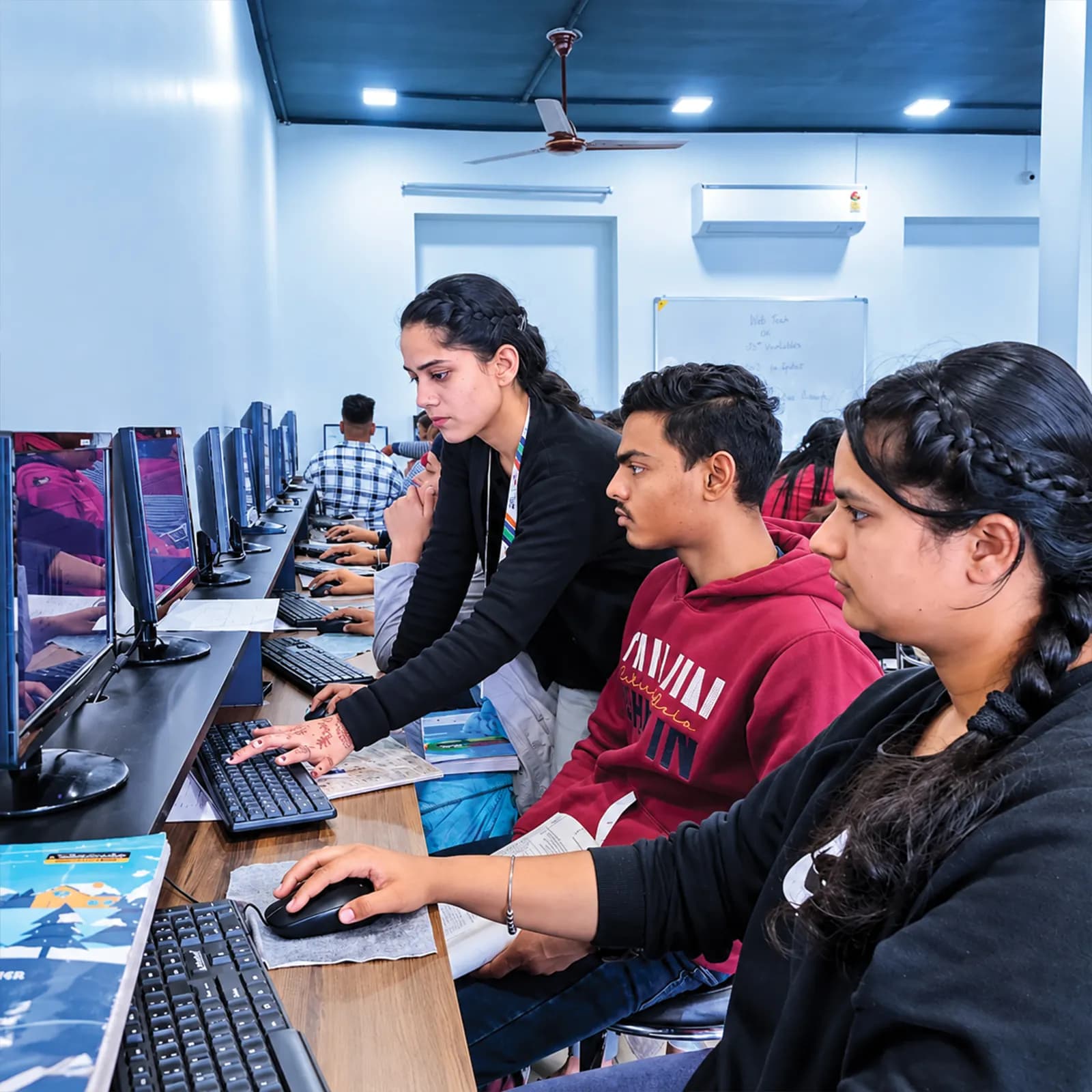 Reviewed by mentors. Built for interviews.
Who can dothis course
Seven different starting points share the same batch, and the syllabus assumes none of them. What decides how far you get is turning up consistently and finishing what each module asks you to build.
Post-12th students exploring tech careers
You have finished 12th, any stream, and have not touched code before. You start at Kotlin basics — variables, loops, functions — with no assumption you know programming. By month two you are building your first working screen, not still reading theory.
CS/IT graduates and final-year students
You know data structures and maybe some Java from college, but you have never shipped an app end to end. This course closes that gap with a real MVVM-architected app on your resume instead of a semester project only your professor saw.
Java developers migrating to Kotlin
You have built Android apps in Java for a few years but keep seeing Kotlin-only job listings. You already understand Android's lifecycle — this course fast-tracks you through Kotlin syntax, null safety and coroutines so you can convert that experience instead of starting over.
Small business owners who want a native app
You run a shop, clinic or service business and are tired of paying freelancers for every small change. You learn enough Kotlin and Firebase to build and maintain a basic native Android app yourself, or brief developers with real technical understanding.
Freelancers who want Android-specific work
You already freelance in some capacity but keep losing Android briefs to specialists. You come out able to quote, scope and deliver a Kotlin app with a Firebase backend and Play Store publishing — the whole job, not just a piece of it.
Career restarters
You took a break — family, a different job, further study — and coding has moved on without you; Kotlin was not even Google's preferred language when you last checked. You rebuild from fundamentals with a trainer answering doubts live, not a stale tutorial video.
Self-taught learners stuck in tutorial hell
You have done four YouTube crash courses and can follow along, but you have never built anything without the video paused next to you, and you have nothing published. This programme forces you through a real build with a mentor reviewing your code, so you leave with a Play Store link, not watch-hours.
One course.A mesh of real tools.
Everything below is installed on the lab machines and used on live client work, not shown once in a slide and forgotten.
- Kotlin
- The programming language Google prefers for Android apps
- Android Studio
- Google's official editor for building, running and testing Android apps
- Jetpack Compose
- The modern way to build Android screens in Kotlin code
- XML Layouts
- The older way to design Android screens, still found in many existing apps
- Coroutines & Flow
- Run network and database work in the background without freezing the app
Get Certified in
Kotlin
Complete the course with a portfolio of live projects and receive an industry-recognised certificate, plus a documented internship letter accepted by Punjab universities.
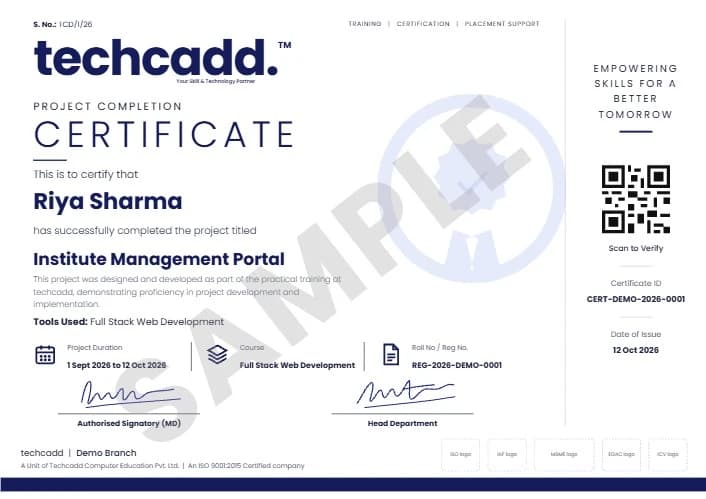
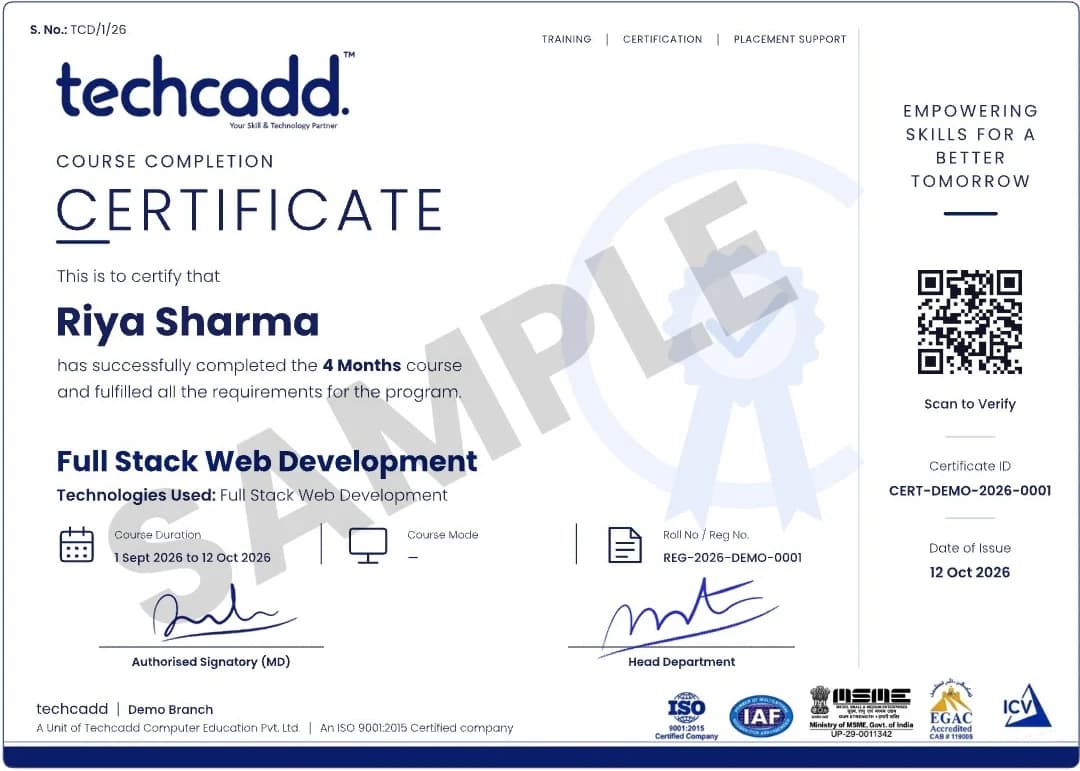
Two certificates on completion — the course certificate and a separate capstone project certificate.
Where this coursetakes you
The roles this opens, what they pay in Punjab and beyond, and who is hiring for them — the same figures our free Salary Estimator publishes, not a brochure number.
Android Developer
Builds native Android applications with Kotlin and Jetpack Compose.
- Starting package
- ₹2.2–4LPA
- After 2 years
- ₹4.5–8LPA
Indicative ranges for Android Developer roles, compiled from public job-market listings and drawn on the same scale in every market. Actual offers vary by employer, skillset and interview performance — Punjab pay typically reaches 2× the fresher ceiling within two years of delivery experience.
Open the salary estimatorWhere Android Developer graduates get hired
- Mobile-first startups and app agencies
- E-commerce companies with native apps
- Enterprise mobility teams
- Freelance app development on Upwork and Toptal
What job roles open up after Kotlin?
This course ends with a published Play Store app, so Android roles open straight away. With one more course you can widen into cross-platform, backend or AI work. The roles fall into two groups:
- Android Developer
- Kotlin Developer
- Mobile App Developer
- Junior Software Engineer (Android)
- Android UI Developer
- Freelance Android Developer
- Flutter / Cross-Platform App Developer (with Flutter course)
- Backend Developer (with Java course)
- Full-Stack Developer (with Web Development course)
- AI Application Developer (with Python and Generative AI courses)
What job roles does this course prepare me for?
Android Developer (core native app development, hired by IT services firms and product companies alike), Kotlin Developer (often at companies actively migrating Java codebases, common in fintech and product startups), Mobile App Developer, Junior Software Engineer (Android), Android UI Developer for Compose and Material Design work, and Freelance Android Developer.
What can I earn, and how fast does it grow?
Indicatively: ₹2–3.8 LPA as a fresher in Punjab and the Tricity, rising to ₹4.5–8 LPA after about two years. Delhi NCR runs higher at ₹3.5–6 LPA for freshers and ₹7–12 LPA after two years, and remote or freelance work sits at ₹4–7 LPA and ₹8–15 LPA respectively. These are based on public India market data for Kotlin and Android roles, not a promise of a specific offer — actual pay depends on your employer, portfolio strength and interview performance.
Why Kotlin rather than Java for Android?
Kotlin has been Google's officially preferred Android language since 2019, so new APIs, sample code and Jetpack libraries are documented Kotlin-first, and Java-only codebases increasingly mean legacy maintenance rather than new builds. Kotlin developers in India typically command a 10–35% premium over Java-only counterparts at equivalent experience.
Can I freelance or work remotely with this skill?
Yes. A Jalandhar address costs you nothing on a remote brief, and remote or freelance Android work is the highest of the three market bands quoted above. The capstone module covers writing a technical proposal, estimating timelines, pricing a project and handling change requests, so you can quote and scope a job rather than only build it.
What actually goes on my resume at the end?
Six portfolio apps, a capstone published live to the Play Store under your own name, a public GitHub repository with reviewed pull requests and passing CI, an Industry Certificate, a documented internship letter, and a Certificate of Project Excellence if your capstone reaches the store.
Your Kotlin careerroadmap
This 3-month course takes you all the way to a published Android app, so for Android roles it is enough to start applying. If you want to reach iPhone users, servers or AI features as well, you add one focused course. Here is how each path looks:
| Goal | Step 1 | Step 2 | Where you arrive |
|---|---|---|---|
| Android Developer | Kotlin Android App Development | Ready to apply | Android / Kotlin Developer |
| Freelance app developer | Kotlin Android App Development | Ready to apply | Freelance Android Developer |
| Android + iOS developer | Kotlin Android App Development | Flutter App Development | Mobile / Cross-Platform App Developer |
| Backend Developer | Kotlin Android App Development | Java (then Spring Boot or Ktor on the job) | Backend / Kotlin Developer |
| Full-stack (apps + websites) | Kotlin Android App Development | Full-Stack / Mobile Developer | |
| AI-powered apps | Kotlin Android App Development | Python → Generative AI | AI Application Developer (mobile) |
Hands-on projectsyou will ship
E-Commerce Shopping App
A full shopping flow — product catalogue, cart and order history — backed by local storage and a live API.
Field: Native Android, APIs & Offline Storage
Food Delivery / Booking App
A delivery-style app with a live booking flow and real-time order tracking on a map.
Field: Native Android, Firebase & Maps
Chat / Social App
Real-time one-to-one messaging with push notifications on every new message.
Field: Native Android, Real-time Firebase & Notifications
Expense / Budget Tracker App
An offline-first personal finance app with visual spending reports.
Field: Native Android, Offline-first Storage
News / Content App
A content feed app with pagination and a clean MVVM-structured codebase.
Field: Native Android, APIs & MVVM Architecture
Capstone: Live Client Android App
A real client brief, built end to end and published live to the Play Store under your name.
Field: Native Android, Play Store Publishing & Client Work
Learn it. Build it. Make it yours.
Every project moves through the same loop: understand the brief, build with guidance, then explain the decisions behind your work.
Understand
Break a real requirement into a clear plan and the right tools.
E-Commerce Shopping AppBuild
Work hands-on with trainer feedback while the decisions are still easy to change.
Food Delivery / Booking AppPresent
Turn the finished work into a portfolio story you can defend in an interview.
Chat / Social AppWhy students choosetechcadd
Most Kotlin and Android programme brochures in Jalandhar list the same module names — MVVM, Firebase, Play Store deployment. That is not where the real difference is; the difference is what happens once class starts.
Trainers who still ship Android apps commercially
They are not reading from year-old slides — they hit the same Play Store review rejections and API changes you will, and teach around them.
Real device testing, not just emulator screenshots
Apps are tested on actual Android phones for the permission prompts, camera quirks and performance issues an emulator will not show you.
Live client briefs, not invented ones
The capstone is built against a real brief with real constraints — scope changes, deadline pressure — because that is what a first Android job actually looks like.
Code review, not just code completion
Every project is reviewed against what a company code reviewer would actually flag: null-safety gaps, architecture shortcuts, unhandled errors.
Batch flexibility around real schedules
Classroom, Weekend and 1-on-1 tracks exist because college timetables, jobs and commutes from places like Phagwara or Hoshiarpur do not leave everyone the same free hours.
A placement support cell, honestly framed
We help with resume review, mock interviews and referrals — we do not promise a job, because no training institute honestly can.
How techcaddcompares
Most Kotlin and Android programme brochures in Jalandhar list the same module names. These are the eight things worth asking about before you pay any institute, including this one.
| Feature | techcadd | Other institutes |
|---|---|---|
| Curriculum currency | Updated for Jetpack Compose and current Firebase SDKs | Often still XML-only, on older Firebase APIs |
| Learning style | Live project builds from day one | Slide-heavy theory, projects bolted on late |
| Trainer background | Actively shipping Android apps commercially | Often full-time trainers only, no current dev work |
| Project realism | A live client brief for the capstone, published to the Play Store | Simulated or sample briefs |
| Device testing | Tested on real Android phones — permissions, camera quirks, performance | Emulator screenshots only |
| Placement support | Resume review, mock interviews and referrals — support, not a guarantee | Varies widely, often undefined |
| Batch flexibility | Classroom, Weekend and 1-on-1 | Usually one fixed format |
| Doubt support | Direct trainer access during and after the batch | Often limited to class hours only |
| Certification | Certificate, internship letter and a capstone excellence certificate | Varies, often a single generic certificate |
Do not take any of this on faith — ours included. Ask any institute you are considering, techcadd too, to show you real apps their students have actually published to the Play Store, not screenshots in a brochure.
What our studentsin Jalandhar say
- Google
I was a career switcher with zero coding background. Six months later I had an app live on the Play Store with my name on it. The trainer reviewed my code line by line — that's what actually taught me.
Rajwinder KaurCareer Switcher · Model Town GoogleI'd been writing Java for three years and kept losing Kotlin-only job listings. This course got me converting real code in weeks, not months.
Harpreet SinghJava Developer moving to Kotlin · Urban Estate GoogleFinal year of my CS degree and I finally had something more than a college project to show — an MVVM app with a working Firebase backend.
Simran KaurFinal-Year CS Student · Adarsh Nagar GoogleI was a career switcher with zero coding background. Six months later I had an app live on the Play Store with my name on it. The trainer reviewed my code line by line — that's what actually taught me.
Rajwinder KaurCareer Switcher · Model Town GoogleI'd been writing Java for three years and kept losing Kotlin-only job listings. This course got me converting real code in weeks, not months.
Harpreet SinghJava Developer moving to Kotlin · Urban Estate GoogleFinal year of my CS degree and I finally had something more than a college project to show — an MVVM app with a working Firebase backend.
Simran KaurFinal-Year CS Student · Adarsh Nagar
- Google
I commute in from Phagwara so the weekend batch was the only way this worked for me. Still got the same live-project pace as the weekday students.
Gurpreet SinghWeekend Learner · Phagwara GoogleThe placement cell followed up with me for weeks after my batch ended, not just on the last day. That mattered more than I expected.
Manpreet KaurPlaced Fresher · Rama Mandi GoogleI'd done four YouTube courses and still had nothing to show. Here I actually published an app — that's the difference.
Amanjot SinghSelf-Taught Learner · Basti Bawa Khel GoogleI commute in from Phagwara so the weekend batch was the only way this worked for me. Still got the same live-project pace as the weekday students.
Gurpreet SinghWeekend Learner · Phagwara GoogleThe placement cell followed up with me for weeks after my batch ended, not just on the last day. That mattered more than I expected.
Manpreet KaurPlaced Fresher · Rama Mandi GoogleI'd done four YouTube courses and still had nothing to show. Here I actually published an app — that's the difference.
Amanjot SinghSelf-Taught Learner · Basti Bawa Khel
Frequently Asked Questions
No. The programme starts from Kotlin fundamentals — variables, functions, OOP — assuming no prior programming experience.
No. Kotlin is taught from scratch. Prior Java knowledge helps you move faster through the Android-specific concepts, but it isn't required.
It's a single 3-month track, Kotlin fundamentals through to a production-signed, published Android app.
Fees depend on mode (Classroom, Weekend, 1-on-1). A counsellor will share the current fee structure and any active offers when you book a demo — call +91 98881 22254 or request a callback.
Anyone 12th pass onward, from any stream — post-12th students, graduates, working professionals, business owners, freelancers and career restarters.
Android Developer, Kotlin Developer, Mobile App Developer, Junior Software Engineer (Android), Android UI Developer and Freelance Android Developer.
Indicatively, ₹2–3.8 LPA in Punjab and the Tricity, ₹3.5–6 LPA in Delhi NCR, and ₹4–7 LPA for remote or freelance work — based on current public market data, not a guaranteed figure.
No — and be wary of anyone who claims to. We provide placement support: resume review, mock interviews and referrals. The outcome depends on your skill level and interview performance.
Kotlin, Android Studio, Jetpack Compose, XML layouts, Firebase (Auth, Firestore, Cloud Messaging, Crashlytics), Room Database, Retrofit, Coroutines and Flow, MVVM architecture, Hilt, WorkManager, ML Kit, Supabase, GitHub Actions, Fastlane, Git and GitHub, Postman, and Play Store deployment.
An Industry Certificate in Kotlin Android App Development issued by techcadd, a documented internship letter based on your project work, and a separate Certificate of Project Excellence for a capstone published to the Play Store. We don't claim affiliation with an external accreditation body — and we'd rather you check what a certificate is actually based on, real client work or a simulated brief, at any institute before you enrol, including this one.
Your capstone is built against a real client brief and published live to the Play Store — it is not a simulation.
Yes. Classroom, Weekend and 1-on-1 formats are available so the schedule fits around college, work or commuting.
Kotlin is used mainly for native Android apps, and also for server-side software and Kotlin Multiplatform projects. This course prepares you directly for Android app and Android UI development, and gives you the language foundation for backend Kotlin, which you would add with Java and a server framework.
No. It is a native Android course. To build apps for both Android and iPhone from one codebase, take techcadd's Flutter App Development course; Kotlin students usually find it quick because the app-building ideas carry over.
Choose Kotlin if you want deep Android skills and roles at product companies or teams that build native Android. Choose Flutter if you want one codebase for Android and iOS, which suits agencies, startups and freelancers. If you are unsure, a counsellor can compare both with you in one demo class.
Yes, Kotlin can run servers using Spring Boot or Ktor, but this course does not teach that. Here your apps connect to REST APIs and Firebase rather than a server you build. If you want backend work, the Java course followed by Spring Boot is the usual route.
Not for the apps in this course. You use Firebase (Authentication, Firestore, Cloud Messaging and Crashlytics) as a ready-made backend, connect to REST APIs with Retrofit, and store data offline with Room. Writing a custom server is a separate backend skill.
No. Agencies, startups and local businesses across Punjab need Android apps too, and freelance Android work is open to anyone with a published app. The capstone also covers proposals, pricing and client handoff, so you can take on client work directly.
Choose the rightduration for you
A single 3-month track, start to finish: Kotlin at absolute zero to a production-signed, published Android app.
Months 1–3 — Foundation: Android & Kotlin
6 modules
Ship a working CRUD Android app with local storage and a clean, responsive UI. Kotlin fundamentals, Android fundamentals, Jetpack Compose, state management, coroutines and a production-signed capstone with a store listing.
| Module | 3 Months |
|---|---|
| 01Kotlin Programming FundamentalsSyntax, control flow, functions, OOP, collections and null safety — from absolute zero to a command-line programme. | Included |
| 02Android FundamentalsActivity lifecycle, Android Studio and the SDK, Activities vs. Fragments, ConstraintLayout and user input. | Included |
| 03Jetpack Compose UI DevelopmentDeclarative UI, Material Design 3, reusable composables, adaptive layouts, Navigation Compose, forms and animations. | Included |
| 04State Managementremember and mutableStateOf, state hoisting, ViewModel, StateFlow and LiveData, and unidirectional data flow. | Included |
| 05Asynchronous ProgrammingCoroutines, suspend functions, Flow, structured concurrency and keeping work off the main thread. | Included |
| 10Month 3 Capstone — Production App & Client HandoffRefactoring, build variants, versioning and store metadata, crash reporting and a technical handoff report. | Included |
Every module is taught and assessed within the 3-month track, closing with a signed, production build published to the Play Store.
Not sure which app development path is right for you?
Tell a counsellor whether you want a job, freelance work or your own app, and we will show you whether native Android with Kotlin, cross-platform Flutter, or both is the better route. Book a free demo class and see the lab before you decide.
Ask aboutKotlin
Send your question and a counsellor will call you back about batch timings, fees, EMI options, placement record, or whether this course fits your degree.
- Free counselling and demo class
- Weekday, evening, weekend or 1-on-1, all 2-hour classes
- Internship letter and placement support